Biosimilars have transformed the treatment landscape for many chronic and complex diseases by providing highly similar alternatives to established biologic medications. Unlike traditional generic drugs, biosimilars are not exact molecular copies of their reference products. Instead, they must demonstrate that they are highly similar to the reference biologic and have no clinically meaningful differences in safety, purity, and effectiveness.
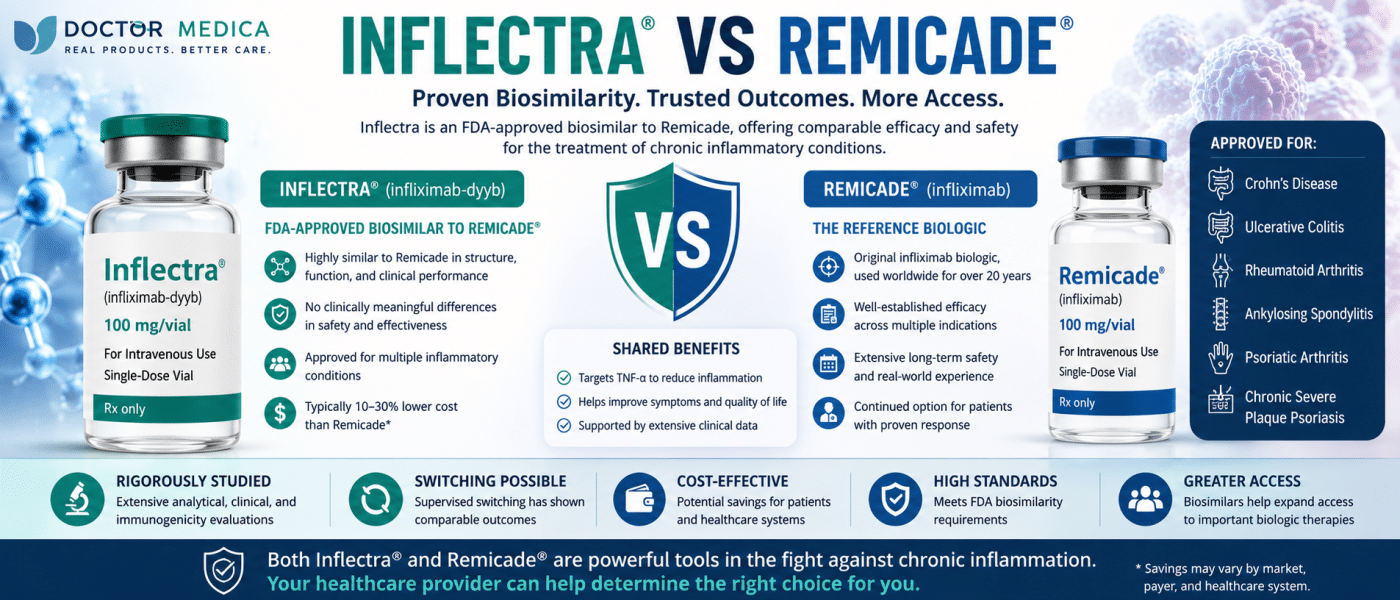
One of the best-known examples is Inflectra (infliximab-dyyb), a biosimilar to Remicade (infliximab). Approved by the U.S. Food and Drug Administration (FDA) in 2016, Inflectra was the first biosimilar monoclonal antibody approved in the United States. It is used for several inflammatory conditions, including Crohn’s disease, ulcerative colitis, rheumatoid arthritis, ankylosing spondylitis, psoriatic arthritis, and chronic severe plaque psoriasis.
Because both products are based on infliximab and target tumor necrosis factor-alpha (TNF-α), Inflectra and Remicade are often discussed as therapeutic alternatives. However, questions remain about their clinical performance, immunogenicity, switching, regulatory status, and cost.
In this article, we’ll explore the key differences and similarities between Inflectra vs Remicade, helping healthcare professionals and patients better understand what biosimilarity means in real-world clinical practice.
Key Takeaways
Inflectra (infliximab-dyyb) is an FDA-approved biosimilar to Remicade (infliximab).
FDA approval requires a biosimilar to be highly similar to its reference product, with no clinically meaningful differences in safety and effectiveness.
Inflectra is approved for multiple inflammatory diseases, including Crohn’s disease, ulcerative colitis, rheumatoid arthritis, ankylosing spondylitis, psoriatic arthritis, and chronic severe plaque psoriasis.
Both Inflectra and Remicade work by blocking TNF-α, an inflammatory signaling protein involved in several autoimmune and inflammatory diseases.
Clinical and regulatory evidence supports the use of Inflectra as a biosimilar to Remicade, although biosimilarity does not mean the two products are molecularly identical.
Inflectra was approved by the FDA as a biosimilar, but not as an interchangeable biosimilar. Pharmacy-level substitution therefore depends on applicable regulatory requirements and should not be assumed automatically.
Switching from Remicade to a biosimilar may be appropriate for many patients, but treatment decisions should be individualized and monitored by the prescribing healthcare professional.
Biosimilars can increase treatment options and may reduce healthcare costs, although actual savings vary according to country, payer, contracts, and market conditions.
About: Doctor Medica is your trusted supplier of top-quality medical products and treatments for healthcare professionals. We offer genuine products from leading brands. If you’re looking to order Remicade online for your medical practice, contact Doctor Medica today.
Recommended Products
Considering a Purchase?
Sign in to Explore Options.
What Makes Inflectra a Biosimilar to Remicade?
To understand the difference between Inflectra and Remicade, it is important to understand what the term biosimilar actually means.
A biosimilar is a biological product that is highly similar to an already approved reference biologic. The FDA requires manufacturers to demonstrate that there are no clinically meaningful differences between the biosimilar and its reference product in terms of safety and effectiveness. Minor differences may exist, particularly because biologic medicines are produced using living systems, but these differences must not affect clinical performance.
Inflectra was developed as a biosimilar to U.S.-licensed Remicade. Its regulatory evaluation included extensive analytical and functional characterization, pharmacokinetic and pharmacodynamic data, immunogenicity assessment, and clinical evidence.
Analytical Comparability
One of the most important stages in biosimilar development is analytical comparison.
Scientists compare the proposed biosimilar with the reference product across multiple characteristics, including:
Protein structure
Functional activity
Binding characteristics
Purity
Stability
Post-translational modifications
Biological activity
These analyses are designed to identify any meaningful differences between the two biologic products.
For Inflectra, the FDA reviewed extensive structural and functional characterization demonstrating a high degree of similarity to Remicade.
Pharmacokinetic and Pharmacodynamic Evaluation
Researchers also examine how the medicine behaves in the body.
Pharmacokinetic studies evaluate characteristics such as:
Absorption
Distribution
Clearance
Exposure
Elimination
For a biosimilar, these studies help establish that the proposed product behaves sufficiently similarly to the reference biologic.
Immunogenicity
Another important consideration is immunogenicity—the possibility that the immune system may recognize a biologic as foreign and produce anti-drug antibodies.
Both Remicade and Inflectra can be associated with immunogenicity because they are biologic therapies. Monitoring treatment response and adverse reactions is therefore an important part of long-term therapy.
Inflectra vs Remicade: How Do They Work?
Both products are based on infliximab, a monoclonal antibody that targets TNF-α.
TNF-α plays an important role in the inflammatory response. Excessive TNF-α activity contributes to inflammation and tissue damage in diseases such as rheumatoid arthritis, inflammatory bowel disease, and psoriatic arthritis.
By binding to TNF-α, infliximab helps reduce inflammatory signaling and can improve symptoms and disease control.
Inflectra uses the same therapeutic target and is administered by intravenous infusion, like the reference product.
The important distinction is that Inflectra is a biosimilar rather than an identical copy of Remicade. The FDA approval pathway focuses on demonstrating high similarity and the absence of clinically meaningful differences rather than reproducing every aspect of the reference product molecule exactly.
Approved Indications for Inflectra
Inflectra is approved in the United States for several inflammatory and autoimmune conditions.
According to the current prescribing information, indications include:
Crohn’s disease
Ulcerative colitis
Rheumatoid arthritis, in combination with methotrexate
Ankylosing spondylitis
Psoriatic arthritis
Chronic severe plaque psoriasis
Certain indications also include pediatric patients aged 6 years and older, depending on the condition.
This broad range of indications reflects the FDA’s biosimilar framework, under which a biosimilar may receive approval for conditions supported through scientific justification and the totality of evidence, even when it has not been studied independently in every individual indication.
Clinical Evidence: Inflectra vs Remicade
The goal of biosimilar development is not to prove that the biosimilar is independently better than the reference product. Instead, the objective is to establish biosimilarity and rule out clinically meaningful differences.
The evidence reviewed for Inflectra included analytical studies, pharmacokinetic and pharmacodynamic assessments, immunogenicity data, and clinical safety and effectiveness information.
Clinical studies have evaluated Inflectra in conditions such as rheumatoid arthritis and ankylosing spondylitis, while regulatory approval also incorporates the totality of evidence and scientific justification for the additional approved indications.
Rheumatoid Arthritis
In rheumatoid arthritis, infliximab therapy is used to reduce inflammatory activity, improve physical function, and inhibit progression of structural joint damage.
Inflectra demonstrated clinical performance consistent with the reference product within the biosimilar development program.
Ankylosing Spondylitis
Inflectra has also been evaluated in patients with ankylosing spondylitis, supporting its use as a biosimilar alternative to Remicade for this indication.
Inflammatory Bowel Disease
Inflectra is approved for Crohn’s disease and ulcerative colitis, including specific pediatric indications for patients aged 6 years and older.
For patients with chronic inflammatory bowel disease, treatment decisions should consider disease severity, previous biologic exposure, response to therapy, immunogenicity, and individual risk factors.
Switching from Remicade to Inflectra
One of the most common questions surrounding biosimilars is whether patients can safely switch from the reference biologic to the biosimilar.
The FDA distinguishes between biosimilarity and interchangeability.
A biosimilar must demonstrate high similarity and no clinically meaningful differences from the reference product. An interchangeable biosimilar must meet additional requirements that allow substitution at the pharmacy level, subject to applicable state laws.
Inflectra was originally approved by the FDA as a biosimilar, not an interchangeable biosimilar.
Therefore, a switch between Remicade and Inflectra should not automatically be interpreted as pharmacy-level substitution.
However, supervised switching between a reference biologic and its biosimilar is an important part of biosimilar use in clinical practice. When a healthcare professional determines that switching is appropriate, patients can be monitored for:
Disease activity
Treatment response
Infusion reactions
Adverse events
Anti-drug antibodies
Changes in drug exposure
Patient concerns or treatment preferences
Patient education is particularly important because concerns about switching can sometimes influence adherence and treatment confidence.
Inflectra vs Remicade: Safety and Side Effects
Because Inflectra is a TNF blocker, its safety considerations are broadly related to the pharmacologic class and include potentially serious risks.
The current prescribing information carries a Boxed Warning concerning serious infections and malignancies. Serious infections can include tuberculosis, bacterial sepsis, invasive fungal infections, and other opportunistic infections.
Other important risks may include:
Infusion reactions
Hypersensitivity reactions
Serious infections
Reactivation of latent infections
Liver injury
Blood disorders
Lupus-like syndrome
Demyelinating disorders
Heart failure-related concerns
Certain malignancies
Infusion-related reactions can occur during or shortly after administration. Reported symptoms may include fever, chills, chest discomfort, changes in blood pressure, shortness of breath, rash, or itching.
Because of these risks, patients should undergo appropriate clinical assessment before and during treatment.
Inflectra vs Remicade: Comparison Table
Feature Remicade Inflectra
Active ingredient Infliximab Infliximab-dyyb
Product type Reference biologic Biosimilar
FDA approval Original biologic FDA-approved biosimilar
Mechanism TNF-α inhibition TNF-α inhibition
Administration Intravenous infusion Intravenous infusion
Major indications Multiple inflammatory diseases Multiple approved indications matching the reference product
Molecularly identical? Reference product No; highly similar biosimilar
Clinically meaningful differences Reference standard None expected based on FDA biosimilarity requirements
Interchangeable designation Reference product Not designated interchangeable by FDA
Safety monitoring Required Required
Cost Generally higher list price May offer cost savings depending on market and payer
The most important point is that biosimilar does not mean inferior. FDA-approved biosimilars must meet rigorous scientific and regulatory standards for similarity, safety, and effectiveness.
Cost and Access: Inflectra vs Remicade
One of the major reasons biosimilars were introduced is to improve access and affordability.
Biologic therapies can represent a substantial portion of healthcare spending. Biosimilars create additional competition and can potentially reduce costs for healthcare systems, insurers, and patients. The FDA notes that biosimilars may improve access and potentially lower costs, although actual savings vary across markets.
The price difference between Inflectra and Remicade should therefore not be presented as a fixed percentage. Actual costs depend on factors such as:
Insurance coverage
Hospital or clinic purchasing agreements
Reimbursement policies
Manufacturer contracts
Regional pricing
Patient assistance programs
Healthcare system policies
For this reason, the lowest-cost option for one patient or healthcare system may not be the same for another.
Inflectra vs Remicade: Which Is Better?
There is no simple answer to whether Inflectra or Remicade is better.
From a regulatory perspective, Inflectra has demonstrated biosimilarity to Remicade, meaning it must be highly similar and have no clinically meaningful differences in safety and effectiveness.
For many patients, the decision may therefore be influenced by practical factors such as:
Insurance coverage
Treatment availability
Healthcare provider preference
Local prescribing guidelines
Previous response to infliximab
Patient preference
Cost and access
Patients already stable on Remicade should discuss any proposed switch with their healthcare provider rather than making changes independently.
What Should Healthcare Providers Consider When Switching?
A successful transition from Remicade to Inflectra involves more than simply changing the product name on a prescription.
1. Review the Patient’s Clinical Status
The patient’s current disease activity and treatment response should be assessed before making a change.
2. Explain Biosimilarity
Patients should understand that a biosimilar is not an inferior version of the reference product. It is a biologic that has met regulatory requirements demonstrating high similarity and no clinically meaningful differences.
3. Discuss Immunogenicity
Patients receiving infliximab products may develop anti-drug antibodies. Clinicians should consider treatment history and clinical response when monitoring patients.
4. Monitor Disease Activity
Following a switch, appropriate clinical monitoring can help identify loss of response or adverse reactions.
5. Consider Local Regulations
The rules governing substitution and prescribing can vary by jurisdiction. In the United States, FDA biosimilar approval does not automatically mean that a product is interchangeable at the pharmacy level.
The Future of Infliximab Biosimilars
Inflectra was approved in 2016, and it helped establish the role of infliximab biosimilars in the U.S. market. Since then, additional infliximab biosimilars have been approved, including Renflexis, Ixifi, and Avsola.
The expanding biosimilar market creates more competition and gives healthcare systems additional options when managing chronic inflammatory diseases.
As experience with biosimilars grows, the focus is increasingly shifting from simply establishing biosimilarity to understanding how these products can improve access, affordability, continuity of care, and long-term treatment sustainability.
Conclusion
Inflectra and Remicade are closely related biologic therapies based on the same active molecule, infliximab. Remicade is the reference biologic, while Inflectra is an FDA-approved biosimilar developed to be highly similar to the reference product without clinically meaningful differences in safety and effectiveness.
Inflectra is approved for a broad range of inflammatory diseases, including Crohn’s disease, ulcerative colitis, rheumatoid arthritis, ankylosing spondylitis, psoriatic arthritis, and chronic severe plaque psoriasis.
For patients and healthcare systems, one of the most significant advantages of biosimilars is the potential to increase access while reducing treatment costs. However, actual savings vary according to healthcare systems, insurance coverage, and market conditions.
When considering a switch from Remicade to Inflectra, the decision should be made with an appropriate healthcare professional. Clinical response, safety, immunogenicity, patient preferences, treatment availability, and local regulatory requirements should all be considered.
Ultimately, Inflectra vs Remicade is not simply a comparison between a “brand” and a “cheaper version.” It is a comparison between a reference biologic and a rigorously evaluated biosimilar designed to provide comparable therapeutic benefits while potentially expanding access to biologic treatment.
FAQs
1. Is Inflectra the same as Remicade?
Inflectra is not molecularly identical to Remicade. It is a biosimilar to Remicade, meaning it has been shown to be highly similar and to have no clinically meaningful differences in safety and effectiveness.
2. Is Inflectra FDA-approved?
Yes. The FDA approved Inflectra (infliximab-dyyb) in April 2016 as a biosimilar to Remicade.
3. Is Inflectra interchangeable with Remicade?
Inflectra was approved as a biosimilar, not an interchangeable biosimilar. FDA interchangeability has additional requirements and relates to pharmacy-level substitution under applicable state laws.
4. What conditions does Inflectra treat?
Inflectra is approved for several conditions, including Crohn’s disease, ulcerative colitis, rheumatoid arthritis, ankylosing spondylitis, psoriatic arthritis, and chronic severe plaque psoriasis.
5. Does Inflectra work as well as Remicade?
FDA approval requires Inflectra to demonstrate high similarity to Remicade and no clinically meaningful differences in safety and effectiveness.
6. Is Inflectra cheaper than Remicade?
Biosimilars can offer cost savings compared with reference biologics, but the actual price difference varies by country, insurance plan, contracts, reimbursement arrangements, and other market factors.
7. Can a patient switch from Remicade to Inflectra?
A healthcare professional may determine that switching is appropriate. Patients should be monitored for disease response, adverse reactions, and other clinically relevant factors following a switch.
8. Does Inflectra have the same side effects as Remicade?
Because both are TNF-blocking infliximab products, they share important safety considerations, including serious infections and infusion reactions. Patients should review the full prescribing information with their healthcare professional before treatment.