Prolia (denosumab) is an important treatment option for patients at increased risk of osteoporotic fractures. Because its effects on bone remodeling are closely linked to the timing of administration, correct dosing, appropriate patient selection, calcium and vitamin D management, and regular monitoring are essential components of safe treatment.
Unlike bisphosphonates, Prolia is a monoclonal antibody that targets RANK ligand (RANKL), reducing osteoclast activity and slowing bone resorption. Its convenient dosing schedule can support treatment adherence, but missed or delayed doses require particular attention because bone turnover can increase rapidly after the effect of denosumab wears off.
This article explores Prolia dosage recommendations, administration techniques, special-population considerations, supplementation, monitoring requirements, and important precautions healthcare professionals should consider when managing patients receiving denosumab.
Key Takeaways
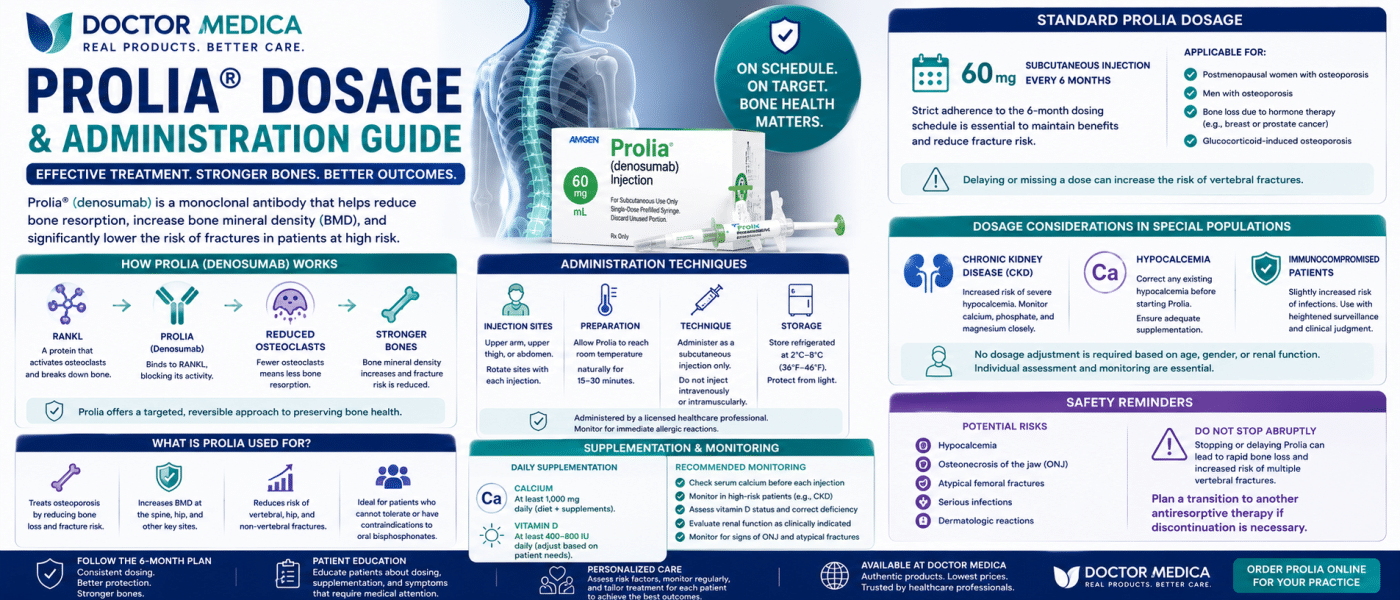
The standard Prolia dose is 60 mg administered subcutaneously once every six months for its approved osteoporosis-related indications.
Prolia is used for several populations at increased fracture risk, including postmenopausal women and men with osteoporosis, as well as certain patients receiving hormone-ablation or glucocorticoid therapy.
Maintaining the six-month dosing schedule is important because discontinuation or significant delays can lead to rapid increases in bone turnover and an increased risk of vertebral fractures.
Existing hypocalcemia should be corrected before treatment, and adequate calcium and vitamin D intake should be maintained during therapy.
Patients with advanced chronic kidney disease, particularly those receiving dialysis or with CKD-mineral and bone disorder, require heightened attention to calcium management because of the risk of severe hypocalcemia.
Prolia should be administered by an appropriately trained healthcare professional using the recommended subcutaneous injection technique.
Regular clinical assessment and appropriate laboratory monitoring can help identify patients at increased risk of complications.
Treatment discontinuation should be planned with an appropriate follow-on osteoporosis therapy when clinically indicated rather than stopping denosumab without a transition strategy.
Standard Prolia Dosage Guidelines
For approved osteoporosis-related indications, the recommended Prolia dosage is 60 mg given as a subcutaneous injection once every six months.
Prolia may be prescribed for:
Postmenopausal women with osteoporosis who are at high risk for fracture.
Men with osteoporosis who are at high risk for fracture.
Patients with glucocorticoid-induced osteoporosis who are at high fracture risk.
Certain patients receiving adjuvant aromatase inhibitor therapy for breast cancer who are at high fracture risk.
Certain men receiving androgen-deprivation therapy for nonmetastatic prostate cancer who are at high fracture risk.
The six-month interval is an important part of treatment. Patients should be encouraged to schedule their next injection in advance so that treatment is not unintentionally delayed.
If a scheduled injection is missed, the prescribing healthcare professional should determine the appropriate timing of the next dose rather than allowing treatment to lapse indefinitely.
How Is Prolia Administered?
Prolia is supplied as a 60 mg/1 mL solution and is administered by subcutaneous injection.
Common injection sites include:
Upper arm
Upper thigh
Abdomen
Healthcare professionals should follow the product’s prescribing information for preparation, storage, handling, and administration. Prolia should be stored appropriately under refrigerated conditions and protected from light until it is ready for use.
Before administration, practitioners should confirm:
The patient’s identity and treatment indication.
The date of the previous injection.
Any history of hypocalcemia or relevant metabolic abnormalities.
Calcium and vitamin D status where clinically appropriate.
Relevant renal and medical history.
Any new medications or conditions that could influence treatment safety.
Patients should also be informed about symptoms that may require prompt medical attention, including symptoms suggestive of hypocalcemia, serious infection, osteonecrosis of the jaw, or atypical femoral fracture.
Prolia Dosage in Special Patient Populations
Although Prolia generally does not require dose adjustment according to age or sex, certain patient groups require additional precautions.
Patients With Chronic Kidney Disease
Renal impairment is particularly important when prescribing denosumab. Unlike bisphosphonates, denosumab is not cleared through the kidneys, so dose adjustment based solely on renal function is generally unnecessary.
However, patients with advanced chronic kidney disease have a substantially higher risk of severe hypocalcemia after Prolia administration. Healthcare professionals should therefore evaluate calcium and vitamin D status and consider the patient’s overall mineral and bone metabolism before treatment.
Patients receiving dialysis require particularly careful management and monitoring.
Patients With Existing Hypocalcemia
Hypocalcemia must be corrected before initiating Prolia.
Adequate calcium and vitamin D intake should be maintained throughout treatment unless contraindicated or otherwise modified by the treating clinician.
Patients at higher risk may require additional laboratory monitoring following administration.
Older Adults
Age alone does not generally require a lower Prolia dose. However, older patients may have multiple risk factors for osteoporosis complications, including nutritional deficiencies, impaired kidney function, falls, and multiple medications.
A comprehensive assessment can therefore be more important than simply adjusting the dose.
Calcium and Vitamin D During Prolia Treatment
Maintaining adequate calcium and vitamin D levels is an important component of Prolia therapy.
The appropriate amount of supplementation varies according to the patient’s dietary intake, laboratory results, age, kidney function, and overall medical condition. Healthcare professionals should determine whether supplementation is necessary and establish an individualized regimen.
Particular attention should be given to patients with:
Vitamin D deficiency
Chronic kidney disease
Malabsorption disorders
Previous episodes of hypocalcemia
Conditions affecting mineral metabolism
Correcting deficiencies before treatment can help reduce the risk of clinically significant calcium disturbances.
Monitoring Before and After Prolia Administration
Patient monitoring should be individualized according to clinical risk.
Depending on the patient’s circumstances, healthcare professionals may evaluate:
Monitoring Area Clinical Consideration
Serum calcium Assess before treatment and monitor more closely in high-risk patients
Vitamin D status Correct deficiency when appropriate
Kidney function Important for identifying patients at increased hypocalcemia risk
Mineral metabolism Additional testing may be appropriate in advanced CKD
Dental health Evaluate risk factors for osteonecrosis of the jaw
Musculoskeletal symptoms Persistent thigh, hip, or groin pain requires clinical assessment
Treatment schedule Track the six-month injection interval carefully
Patients should also receive clear instructions about when to contact their healthcare provider.
Symptoms such as muscle cramps, spasms, tingling, numbness, confusion, or seizures may indicate significant hypocalcemia and require urgent medical evaluation.
Why Prolia Should Not Be Stopped Abruptly
One of the most important considerations with Prolia is what happens when treatment is discontinued.
Because denosumab suppresses bone resorption without remaining deposited in bone for years, its effects diminish after treatment is stopped. This can be followed by a rapid increase in bone turnover, loss of bone mineral density, and an increased risk of multiple vertebral fractures.
For this reason, patients and healthcare professionals should discuss a discontinuation or transition plan before stopping Prolia. An appropriate alternative antiresorptive treatment may be recommended to reduce the risk associated with rebound bone loss.
Patients should never intentionally delay or discontinue Prolia without consulting their healthcare provider.
Prolia Safety Considerations
Prolia is generally well tolerated, but healthcare professionals should remain alert to potentially significant adverse effects.
Commonly reported reactions may include:
Back or musculoskeletal pain
Pain in the extremities
Hypercholesterolemia
Cystitis
Skin-related reactions such as dermatitis or eczema
Rare but clinically important complications include:
Severe hypocalcemia
Osteonecrosis of the jaw (ONJ)
Atypical femoral fractures
Serious infections in susceptible patients
Dermatologic hypersensitivity reactions
Risk assessment should therefore be incorporated into every treatment plan rather than focusing solely on the injection itself.
Conclusion
Understanding Prolia dosage and administration is essential for achieving the intended benefits of denosumab therapy while minimizing preventable complications. The standard 60 mg subcutaneous injection every six months provides a convenient treatment schedule, but successful long-term management depends on more than simply administering the correct dose.
Healthcare professionals should pay particular attention to calcium and vitamin D status, kidney disease, treatment adherence, laboratory monitoring, dental health, and discontinuation planning. Patients should also understand the importance of maintaining their injection schedule and communicating any new or unusual symptoms to their healthcare provider.
With appropriate patient selection, careful monitoring, and a well-planned long-term strategy, Prolia can play an important role in reducing fracture risk and preserving bone health in appropriately selected patients.