Collagen is one of the most important proteins responsible for maintaining skin firmness, elasticity, and structural support. As we age, natural collagen production gradually declines, contributing to wrinkles, skin laxity, reduced volume, and changes in facial and body contours.
As patients increasingly seek aesthetic treatments that deliver natural-looking results without surgery, collagen-stimulating injectables have become an important part of modern aesthetic medicine. Unlike traditional fillers that primarily provide immediate volume, Lanluma works by stimulating the body’s own collagen-production processes, allowing improvements to develop progressively over time.
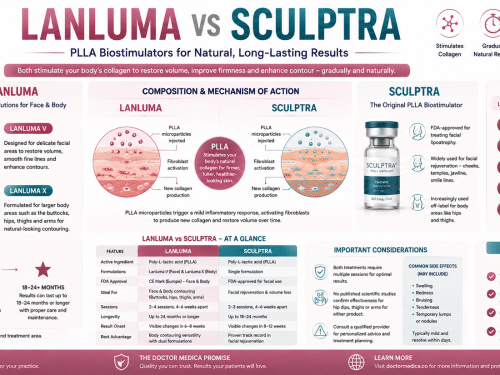
Lanluma is based on poly-L-lactic acid (PLLA), a biodegradable and biocompatible material used in medicine for decades. By encouraging fibroblast activity and new collagen formation, Lanluma can help improve skin quality, firmness, volume, and contour.
In this article, we explore what Lanluma is, how it works, where it can be used, how it compares with traditional dermal fillers, and what patients and practitioners should consider before treatment.
Key Takeaways
Lanluma is a PLLA-based collagen biostimulator designed to encourage the body’s natural collagen production.
Unlike hyaluronic acid fillers, Lanluma does not primarily work by immediately adding volume. Instead, results develop gradually as new collagen is produced.
The treatment can be used for selected facial and body aesthetic indications, depending on the formulation, regulatory status, and practitioner assessment.
Results typically develop over several weeks to months, creating a progressive and natural-looking improvement.
Treatment commonly involves multiple sessions, with the exact protocol individualized according to the patient’s anatomy, skin quality, and aesthetic objectives.
Temporary swelling, bruising, redness, or tenderness may occur following treatment.
Proper patient selection, product preparation, injection technique, and aftercare are essential for achieving predictable results and minimizing complications.
Lanluma is particularly attractive to patients who prefer gradual rejuvenation rather than an immediately visible change.
What Makes Lanluma Different From Traditional Dermal Fillers?
One of the most important differences between Lanluma and conventional dermal fillers is how the treatment creates its aesthetic effect.
Traditional hyaluronic acid (HA) fillers provide volume primarily through the physical presence of the injected gel. This can create an immediate improvement in areas affected by volume loss, such as the cheeks, lips, chin, or nasolabial region.
Lanluma takes a different approach.
Its active component, poly-L-lactic acid, acts as a biostimulatory material. Rather than simply replacing lost volume, it encourages the body’s tissues to produce new collagen. The resulting improvement therefore develops progressively.
This makes Lanluma particularly suitable for patients who want:
Gradual facial rejuvenation.
Improved skin firmness and elasticity.
Restoration of lost structural support.
Subtle enhancement rather than an overfilled appearance.
Longer-lasting changes associated with collagen remodeling.
The distinction is important when discussing expectations. Lanluma is not designed to provide the same immediate volumizing effect as a conventional HA filler.
How Does Lanluma Work?
The science behind Lanluma is based on collagen stimulation.
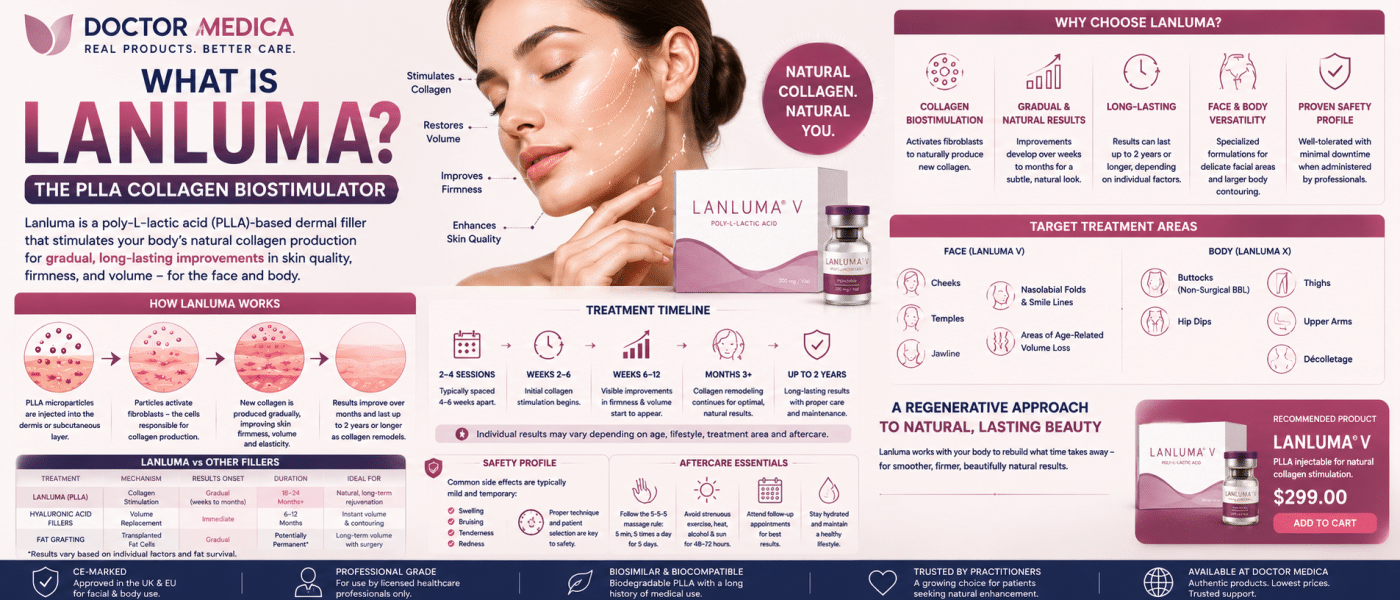
After appropriate injection, PLLA particles interact with the surrounding tissue and stimulate a controlled biological response. Fibroblasts—the cells responsible for producing extracellular matrix components including collagen—become involved in the remodeling process.
Over time, newly produced collagen can contribute to:
Improved skin firmness
Greater elasticity
Enhanced tissue density
Gradual volume restoration
Smoother skin texture
Improved facial or body contours
The process is gradual rather than immediate. This is one reason why patients may initially see little change once the early post-treatment swelling has subsided.
As collagen remodeling progresses, the treated area can become progressively firmer and more structured.
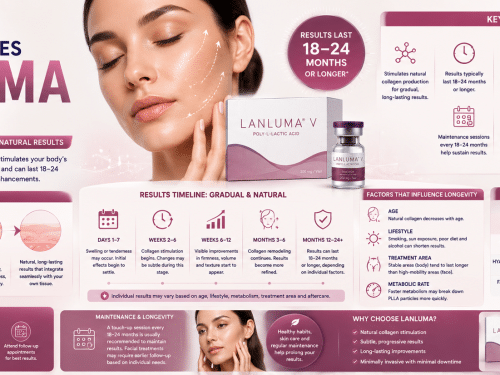
The Lanluma Results Timeline
Stage What Patients May Notice
Immediately after treatment Mild swelling, redness, tenderness, or temporary fullness may occur.
First few weeks Initial treatment-related swelling settles while collagen stimulation begins.
Weeks 6–12 Early improvements in firmness, texture, and contour may become more noticeable.
Several months Continued collagen remodeling can produce more visible structural improvement.
Long term Results can gradually decline as the natural aging process continues, with maintenance individualized to the patient.
Individual outcomes vary according to factors such as age, skin quality, treatment area, treatment plan, lifestyle, and biological response.
Where Can Lanluma Be Used?
One of Lanluma’s distinguishing characteristics is its potential application across different aesthetic treatment areas.
Depending on the specific product formulation, regulatory authorization, and practitioner assessment, PLLA-based biostimulation may be considered for areas affected by volume loss, skin laxity, or reduced tissue quality.
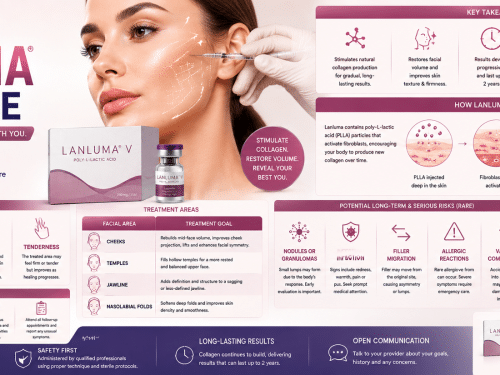
Facial Applications
Facial treatment may focus on areas such as:
Cheeks – to address mid-face volume loss and improve facial proportions.
Temples – to soften a hollow or sunken appearance.
Jawline – to support a more defined lower-face contour.
Lower face – to improve overall structural balance.
Areas of skin laxity – where collagen stimulation may improve tissue quality.
Rather than simply filling an individual wrinkle, the treatment strategy can focus on improving the overall architecture and quality of the surrounding tissue.
Body Applications
In appropriate clinical settings, PLLA-based body treatments may be considered for concerns such as:
Buttock contour irregularities.
Hip dips.
Thigh skin laxity.
Certain areas of reduced skin firmness.
Body areas where improved collagen density may contribute to a smoother appearance.
Body applications require particularly careful patient selection and treatment planning because larger areas may require different treatment strategies than the face.
Lanluma and Collagen: Why the Regenerative Approach Matters
Traditional aesthetic treatments often focus on replacing what has been lost.
Biostimulation focuses on encouraging the body to rebuild part of that structure itself.
This distinction has become increasingly important as patients move away from dramatic cosmetic changes and toward the concept of “natural-looking rejuvenation.”
With Lanluma, the objective is not necessarily to make the treated area look immediately different. Instead, the aim is to support gradual improvements in skin quality, firmness, and structural volume.
This can produce results that develop subtly enough that patients may simply appear more refreshed or rejuvenated, rather than obviously treated.
Lanluma vs. Hyaluronic Acid Fillers
Although both treatments are injectable aesthetic procedures, their mechanisms and clinical objectives are different.
Feature Lanluma / PLLA Hyaluronic Acid Fillers
Primary mechanism Collagen stimulation Immediate volume replacement
Main ingredient Poly-L-lactic acid Hyaluronic acid
Results Gradual Generally immediate
Collagen stimulation Yes Limited/variable depending on product
Best suited for Progressive rejuvenation and tissue quality Precise volumization and contouring
Treatment timeline Weeks to months Immediate with further settling
Reversibility Not rapidly reversible like HA Many HA products can be treated with hyaluronidase
Patient expectation Gradual transformation Immediate correction
Neither approach is universally superior. The appropriate treatment depends on the patient’s anatomy, goals, skin condition, treatment area, and clinical assessment.
In some aesthetic plans, different modalities may also be used sequentially or in combination.
Treatment Planning and Patient Selection
Successful biostimulation begins long before the injection.
A comprehensive consultation should evaluate:
Skin Quality
Practitioners should assess skin thickness, elasticity, laxity, texture, and overall tissue quality.
Volume Loss
The clinician should determine whether the patient’s concern is caused primarily by:
Volume deficiency.
Skin laxity.
Structural changes.
Soft-tissue descent.
A combination of these factors.
Facial or Body Anatomy
Individual anatomy strongly influences treatment planning. A strategy that works well for one patient may not be appropriate for another.
Patient Expectations
Lanluma is generally better suited to patients who understand that collagen production takes time.
Someone seeking an immediate change before an important event may be better suited to a treatment that produces more predictable immediate volume.
Clear communication before treatment helps avoid unrealistic expectations.
Safety, Side Effects, and Important Considerations
As with any injectable aesthetic procedure, Lanluma treatment can be associated with adverse effects.
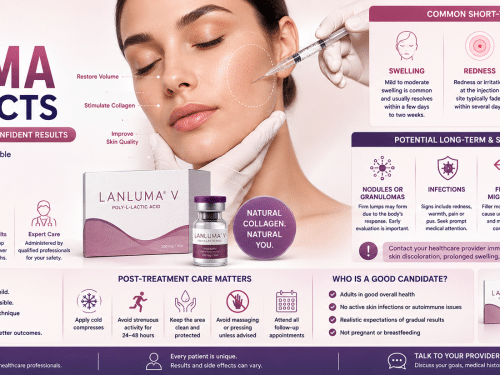
Common short-term reactions can include:
Swelling.
Redness.
Bruising.
Tenderness.
Temporary sensitivity at injection sites.
These reactions are generally temporary, but patients should receive individualized instructions from their treating clinician.
More significant complications can occur with injectable treatments, particularly when products are administered incorrectly or when appropriate patient selection and sterile technique are not followed.
For this reason, treatment should be performed by a qualified medical professional with appropriate knowledge of facial and body anatomy and the specific product protocol.
Patients should also disclose relevant medical history, medications, allergies, previous aesthetic treatments, and any active skin conditions before treatment.
What Can Patients Expect After Treatment?
One of the most important aspects of Lanluma treatment is understanding that the result is progressive.
Patients should not judge the final outcome immediately after their appointment.
The initial appearance can be influenced by temporary swelling and other treatment-related effects. Once these settle, the visible result may initially appear modest. The collagen-building process then continues over the following weeks and months.
This gradual development is one of Lanluma’s key advantages for patients who prefer subtle aesthetic changes.
Aftercare
Post-treatment instructions vary according to the treatment area and clinician protocol. Patients may be advised to:
Follow the practitioner’s recommended massage protocol where applicable.
Avoid unnecessary pressure or manipulation of the treated area unless specifically instructed.
Temporarily limit strenuous physical activity.
Minimize excessive heat exposure during the early recovery period.
Protect the treated skin from excessive sun exposure.
Attend scheduled follow-up appointments.
Contact their provider if they experience unusual or persistent symptoms.
Following individualized aftercare instructions supports recovery and allows the practitioner to monitor the developing result.
How Long Can Lanluma Results Last?
Because Lanluma’s effects are associated with collagen remodeling rather than simple temporary gel volume, improvements can persist after the initial treatment course.
However, longevity is highly individual.
Factors that may influence the duration and quality of results include:
Age.
Baseline collagen production.
Skin quality.
Lifestyle.
Sun exposure.
Smoking.
Weight changes.
Treatment area.
Number of treatment sessions.
Individual metabolic and biological factors.
As the natural aging process continues, collagen gradually declines again. Maintenance treatment may therefore be considered when clinically appropriate.
Why Is Lanluma Becoming Popular in Aesthetic Medicine?
The growing interest in collagen biostimulation reflects a broader change in aesthetic preferences.
Many patients are no longer looking exclusively for more volume. Instead, they want improvements in:
Skin quality + firmness + structure + natural-looking contours.
Lanluma addresses this philosophy by working with the body’s own regenerative processes.
Its gradual mechanism can be particularly appealing to individuals who want to avoid a dramatic or immediately recognizable cosmetic change.
For aesthetic practices, it also provides another option for patients whose concerns cannot be adequately addressed through conventional volumizing fillers alone.
Conclusion
Lanluma is more than a traditional dermal filler—it is a collagen biostimulator designed to encourage the body’s natural tissue-remodeling processes.
Its PLLA-based mechanism allows improvements in skin firmness, elasticity, tissue quality, and volume to develop progressively rather than appearing immediately after injection.
This makes Lanluma an attractive option for patients seeking natural-looking, gradual rejuvenation of selected facial and body areas.
However, successful treatment depends on more than the product itself. Patient selection, anatomical assessment, individualized treatment planning, appropriate administration, realistic expectations, and careful follow-up all play important roles in achieving safe and satisfactory outcomes.
For patients considering Lanluma, the most important question is not simply “Will it add volume?” but rather “Is collagen biostimulation the right approach for my anatomy, skin quality, and aesthetic goals?”
When appropriately selected and professionally administered, Lanluma can offer a regenerative approach to aesthetic medicine—helping patients achieve subtle, progressive, and natural-looking improvements without relying solely on immediate volume replacement.