Fat-dissolving injections have become an increasingly popular option for people seeking to improve localized areas of unwanted fat without undergoing surgery. Among the best-known treatments is Kybella, an injectable containing deoxycholic acid that is specifically indicated for improving the appearance of moderate to severe fullness associated with submental fat, commonly known as a double chin.
At the same time, Lemon Bottle has gained significant attention within the aesthetic market. It is promoted as an injectable solution containing ingredients such as bromelain, lecithin, and riboflavin, with claims of supporting localized fat reduction through a different approach.
Although both products are marketed in the context of fat reduction, they should not be considered equivalent. Kybella has undergone clinical development and has FDA-approved use for submental fat, while the evidence and regulatory status surrounding Lemon Bottle are substantially different.
So, how do Lemon Bottle and Kybella compare?
In this article, we’ll examine their formulations, proposed mechanisms, treatment areas, clinical evidence, safety considerations, treatment schedules, and regulatory status to help healthcare professionals and patients understand the key differences.
Key Takeaways
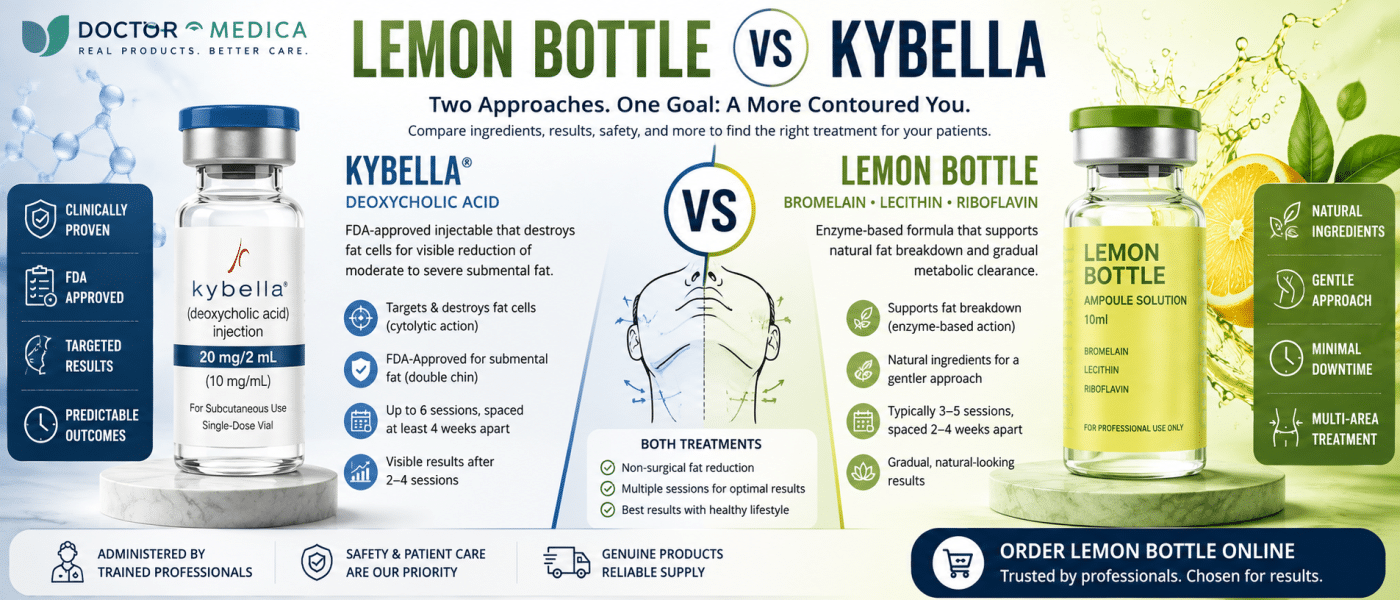
Kybella contains deoxycholic acid, a cytolytic agent that disrupts the membranes of fat cells in the treated area.
In the United States, Kybella is FDA-approved for improving the appearance of moderate to severe submental fat in adults. Its safe and effective use outside the submental region has not been established.
Kybella treatment may involve multiple sessions, with treatments administered at intervals of at least one month and up to six treatments according to the prescribing information.
Lemon Bottle is marketed with ingredients including bromelain, lecithin, and riboflavin and is promoted as an alternative approach to localized fat reduction.
Unlike Kybella, Lemon Bottle does not have the same level of regulatory approval and clinical evidence supporting its use for fat reduction.
Swissmedic warned in 2024 against the use of Lemon Bottle after laboratory analysis of samples found discrepancies between declared and detected ingredients and stated that a medicinal effect had not been scientifically demonstrated.
Choosing between treatments should involve careful consideration of evidence, regulatory status, treatment area, expected results, and safety, rather than marketing claims alone.
About: Doctor Medica is your trusted supplier of top-quality dermal fillers, viscosupplements, and more for your medical practice. We offer genuine products from leading brands at competitive prices. If you’re looking to order Lemon Bottle online for your practice, contact Doctor Medica today.
Recommended Products
Considering a Purchase?
Sign in to Explore Options.
Lemon Bottle vs Kybella: Ingredients and Mechanism of Action
The most fundamental difference between Lemon Bottle and Kybella is their formulation and the evidence supporting how each product works.
Kybella: Deoxycholic Acid
Kybella contains deoxycholic acid, a synthetic form of a naturally occurring bile acid. When injected into submental fat, deoxycholic acid disrupts adipocyte cell membranes, resulting in the destruction of fat cells. The body’s subsequent inflammatory and clearance processes remove cellular debris and lipids.
Because the treatment is designed specifically for the submental area, appropriate injection technique and knowledge of local anatomy are essential.
The FDA prescribing information specifies a maximum of 50 injections per treatment, with individual injections spaced approximately 1 cm apart. Up to six treatments may be administered, with intervals of at least one month between sessions.
Lemon Bottle: Bromelain, Lecithin, and Riboflavin
Lemon Bottle is marketed using a different formulation. Product descriptions commonly identify ingredients such as:
Bromelain
Lecithin
Riboflavin (vitamin B2)
The product is promoted as supporting the breakdown and metabolism of localized fat through an enzyme-based approach.
However, it is important to distinguish between the biological properties of individual ingredients and evidence demonstrating that the finished injectable product produces predictable fat reduction in humans.
The clinical evidence for Lemon Bottle remains considerably more limited than that available for Kybella. In 2024, Swissmedic reported that laboratory analysis of Lemon Bottle samples found that declared ingredients did not correspond consistently with the substances detected, with some samples containing none of the listed ingredients. The regulator also stated that a medicinal effect had not been scientifically demonstrated.
This makes product verification and regulatory status particularly important when evaluating Lemon Bottle.
Lemon Bottle vs Kybella: Treatment Areas
Another major difference between the two products is their intended treatment scope.
Kybella
Kybella is specifically indicated in the United States for submental fat in adults.
This means that its FDA-approved indication is focused on the area beneath the chin. The FDA labeling explicitly states that safe and effective use for subcutaneous fat outside the submental region has not been established and is not recommended.
This targeted indication makes Kybella particularly relevant for patients concerned about:
Double chin
Submental fullness
Moderate to severe fullness beneath the chin
Facial and neck profile
Lemon Bottle
Lemon Bottle is marketed for a broader range of areas, including:
Double chin
Jawline
Abdomen
Flanks
Thighs
Arms
Other areas of localized fat
However, broader marketing claims should not be interpreted as evidence that the product has been clinically validated for each of these treatment areas.
The suitability of any injectable procedure depends on the patient’s anatomy, the specific product being used, the treatment area, and the practitioner’s qualifications.
Treatment Protocols: Lemon Bottle vs Kybella
Treatment protocols can vary significantly, and the established prescribing information for Kybella should not be used to create a protocol for Lemon Bottle.
Feature Kybella Lemon Bottle
Active formulation Deoxycholic acid Marketed with bromelain, lecithin, riboflavin and other ingredients
U.S. FDA-approved indication Submental fat in adults No equivalent FDA-approved indication established
Primary treatment area Under the chin Marketed for facial and body areas
Treatment schedule Up to 6 treatments, at least 1 month apart No universally established evidence-based schedule
Clinical evidence Supported by clinical development and regulatory review Limited independent clinical evidence
Injection approach Structured subcutaneous injection technique Technique and protocols vary by product and practitioner
Key consideration Established regulatory indication Significant uncertainty regarding evidence and product consistency
For Kybella, the FDA-approved treatment involves injections into submental fat using a defined dosing and injection approach. Healthcare professionals administering the product must understand relevant anatomy and use appropriate injection techniques.
With Lemon Bottle, practitioners should avoid assuming that protocols promoted online or by individual clinics represent standardized, clinically validated treatment guidelines.
Kybella Results and Treatment Timeline
Kybella has a more established evidence base than Lemon Bottle, particularly for submental fat reduction.
According to the FDA prescribing information, patients may receive up to six treatments, with each treatment separated by at least one month. The actual number of treatments required depends on the individual’s anatomy and treatment goals.
Results develop progressively rather than immediately. Because Kybella works by disrupting fat cells and triggering the body’s clearance response, visible contour changes generally become more apparent over time.
Not every patient requires the maximum number of treatments. The treatment plan should be reassessed after each session to determine whether additional treatment is appropriate.
Lemon Bottle Results and Treatment Timeline
Lemon Bottle is commonly marketed as producing gradual localized fat reduction, with some aesthetic providers recommending multiple sessions.
However, there is currently insufficient high-quality evidence to establish a universal number of treatments or a predictable percentage of fat reduction.
This is one of the most important distinctions between Lemon Bottle and Kybella.
For Kybella, treatment parameters have been evaluated through clinical development and incorporated into FDA-approved prescribing information. For Lemon Bottle, claims regarding treatment frequency, speed of results, and degree of fat reduction should be treated as product- or practitioner-specific claims rather than established clinical standards.
Patients should therefore be cautious about guarantees such as a specific number of sessions or a predetermined percentage of fat loss.
Lemon Bottle vs Kybella: Safety and Side Effects
Both treatments involve injections, meaning that appropriate medical technique and patient selection are essential.
Kybella Safety Profile
Common reactions associated with Kybella include:
Swelling
Bruising
Pain
Numbness
Redness
Induration
Lumps or nodules
Tightness
Temporary sensory changes
More serious complications can occur. The FDA labeling specifically warns about marginal mandibular nerve injury, which can result in an asymmetric smile or facial muscle weakness, as well as difficulty swallowing.
The risk of complications emphasizes why Kybella should be administered by an appropriately trained healthcare professional who understands the anatomy of the submental region.
Lemon Bottle Safety Considerations
Because the clinical evidence and regulatory oversight surrounding Lemon Bottle are more limited, its complete safety profile is less well established.
Potential complications associated with injectable aesthetic procedures may include:
Pain
Redness
Swelling
Bruising
Inflammation
Infection
Skin injury
Uneven contour
Tissue damage
Nerve or vascular injury
There is an additional concern surrounding product consistency.
Swissmedic reported in 2024 that laboratory analysis of Lemon Bottle samples from different sources showed substantial differences between declared and detected ingredients. In some samples, the listed ingredients were not detected.
This finding highlights an important issue: the safety and effectiveness of an injectable product depend not only on its advertised formulation but also on manufacturing quality, authenticity, storage, and regulatory oversight.
Lemon Bottle vs Kybella: Regulatory Status
Regulatory status is arguably the most important distinction between the two products.
Kybella
Kybella underwent FDA regulatory review and has an approved indication for improving the appearance of moderate to severe submental fat in adults. Its prescribing information establishes specific dosing, administration, warnings, contraindications, and safety information.
Lemon Bottle
Lemon Bottle does not have an equivalent FDA-approved indication for fat reduction.
Regulatory status can also vary by country. For example, Swissmedic issued a warning in March 2024 stating that Lemon Bottle was not authorized for sale or use in Switzerland and should not be marketed as a cosmetic product when administered by injection.
Swissmedic’s laboratory findings also raised concerns regarding the consistency between product labeling and the actual composition of tested samples.
For practitioners, this means that local regulatory requirements should always be checked before purchasing or administering an injectable product.
Which Treatment Is More Predictable?
When it comes to predictability, Kybella currently has the stronger evidence base.
Its formulation, administration, safety warnings, and approved indication have been evaluated through the FDA regulatory process. This does not mean that every patient will achieve identical results, but it does provide a substantially more established framework for treatment.
Lemon Bottle may be attractive to patients and practitioners because it is marketed as a different or gentler approach. However, the limited clinical evidence means that its results are harder to predict.
Therefore, the choice should not simply be framed as:
“Kybella is stronger, while Lemon Bottle is gentler.”
A more accurate comparison is:
Kybella has an established regulatory and clinical evidence base for a specific indication, while Lemon Bottle has greater uncertainty surrounding its clinical effectiveness, formulation consistency, and regulatory status.
Lemon Bottle vs Kybella: Which Is Better?
There is no universal answer because the products are not directly interchangeable.
For an adult seeking treatment for moderate to severe submental fat, Kybella has a clear FDA-approved indication and established dosing framework.
Lemon Bottle may be considered by some aesthetic practitioners for localized fat reduction, but its evidence base is much less established. Concerns about product composition and regulatory status also mean that additional caution is warranted.
Before selecting any injectable fat-reduction treatment, patients should consider:
Whether the product is approved for the intended use
Whether there are peer-reviewed clinical studies
Who will administer the treatment
Whether the practitioner is appropriately qualified
What adverse effects are possible
Whether the product is sourced through a reliable supply chain
Whether the expected results are realistic
What Should Practitioners Consider?
For aesthetic professionals, the comparison between Lemon Bottle and Kybella extends beyond efficacy.
Before introducing an injectable treatment into clinical practice, practitioners should evaluate:
Product Authenticity
The product should be obtained through an appropriate and verifiable supply chain. This is particularly important when purchasing products that are widely marketed through social media or unofficial online channels.
Regulatory Compliance
Practitioners should confirm whether the product is legally authorized for the intended use in their jurisdiction.
Evidence Quality
Marketing materials, before-and-after photographs, testimonials, and social media popularity should not replace peer-reviewed clinical evidence.
Patient Selection
Patients should be evaluated individually, including assessment of anatomy, medical history, expectations, and potential contraindications.
Informed Consent
Patients should understand not only the potential benefits but also the uncertainties and risks associated with the selected treatment.
Conclusion
Lemon Bottle and Kybella are often compared because both are marketed in the context of injectable fat reduction, but they are fundamentally different products.
Kybella contains deoxycholic acid and has an FDA-approved indication for improving the appearance of moderate to severe submental fat in adults. Its treatment parameters, safety warnings, and administration requirements are supported by regulatory review and clinical development.
Lemon Bottle, meanwhile, is marketed as an alternative formulation containing ingredients such as bromelain, lecithin, and riboflavin. However, its clinical evidence is considerably more limited, and regulatory authorities have raised concerns about its use and product consistency. Swissmedic’s analysis of samples in 2024 found discrepancies between labeled and detected ingredients and stated that a medicinal effect had not been scientifically demonstrated.
For this reason, the two treatments should not be presented as equally validated alternatives.
For patients considering injectable fat reduction, the most important factors are clinical evidence, regulatory status, practitioner qualifications, product authenticity, and realistic expectations. A qualified healthcare professional can help determine whether an injectable treatment is appropriate and which evidence-supported option best matches the patient’s needs.
FAQs
1. Is Lemon Bottle better than Kybella?
There is not enough high-quality evidence to conclude that Lemon Bottle is better than Kybella. Kybella has an established FDA-approved indication for submental fat, while Lemon Bottle has a much more limited clinical evidence base.
2. What is the main difference between Lemon Bottle and Kybella?
Kybella uses deoxycholic acid to disrupt fat-cell membranes. Lemon Bottle is marketed with ingredients including bromelain, lecithin, and riboflavin and is promoted as a different approach to localized fat reduction.
3. Is Kybella FDA-approved?
Yes. In the United States, Kybella is FDA-approved for improving the appearance of moderate to severe fullness associated with submental fat in adults. Its safe and effective use outside the submental region has not been established.
4. Is Lemon Bottle FDA-approved?
Lemon Bottle does not have an equivalent FDA-approved indication for fat reduction. Its regulatory status may also vary by country, so practitioners should verify local requirements before use.
5. How many Kybella treatments are needed?
The FDA prescribing information allows for up to six treatments, with sessions administered at intervals of at least one month. The number needed varies between patients.
6. How many Lemon Bottle treatments are needed?
There is no universally established, evidence-based treatment schedule for Lemon Bottle. Recommendations found online can vary, and practitioners should not treat marketing claims as standardized clinical guidance.
7. Which treatment has more clinical evidence?
Kybella has substantially more established clinical and regulatory evidence for its approved use than Lemon Bottle.
8. Can Kybella be used on the abdomen or thighs?
In the United States, Kybella’s FDA-approved indication is for submental fat in adults. The FDA labeling states that safe and effective use for subcutaneous fat outside the submental region has not been established.
9. Is Lemon Bottle safe?
Its complete safety profile has not been established as comprehensively as that of FDA-approved injectable treatments. Additional concerns have been raised by Swissmedic regarding product composition and lack of demonstrated medicinal effect in tested samples.
10. Should patients choose Lemon Bottle or Kybella?
The decision should be based on the treatment area, medical history, regulatory status, evidence, product authenticity, and individual goals. Patients should consult an appropriately qualified healthcare professional before undergoing either injectable treatment.