Osteoarthritis (OA) is one of the most common degenerative joint disorders, affecting millions of people worldwide. Characterized by the progressive loss of cartilage, OA leads to joint pain, stiffness, inflammation, and reduced mobility that can significantly impact daily life. Although lifestyle modifications, physical therapy, and pain medications remain first-line treatments, many patients eventually seek longer-lasting solutions that can improve joint function without surgery.
Among the most widely used injectable therapies are Hyalgan and Synvisc, two viscosupplementation products designed to restore lubrication inside the knee joint. Both treatments contain forms of hyaluronic acid, a naturally occurring substance that helps cushion joints and reduce friction during movement. However, they differ in their composition, injection schedule, and clinical performance.
This article compares Hyalgan and Synvisc, highlighting their formulations, mechanisms of action, effectiveness, and key differences to help healthcare professionals and patients make informed treatment decisions.
Key Takeaways
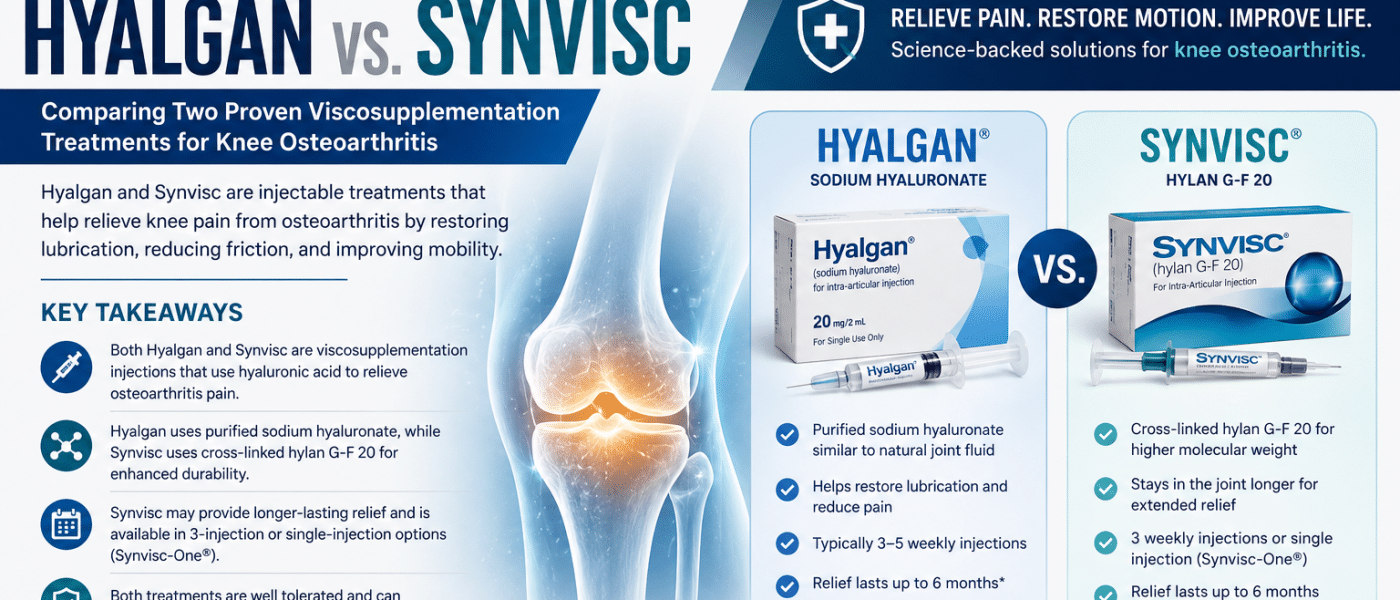
Hyalgan and Synvisc are viscosupplementation injections used to relieve knee pain caused by osteoarthritis.
Both products contain hyaluronic acid but differ in molecular structure and manufacturing process.
Hyalgan consists of purified sodium hyaluronate, while Synvisc contains cross-linked hylan G-F 20 for enhanced durability.
Synvisc generally requires fewer injections and may provide longer-lasting symptom relief for some patients.
Treatment selection depends on disease severity, patient response, physician preference, and individual treatment goals.
What Is Viscosupplementation?
Viscosupplementation is a minimally invasive treatment that involves injecting hyaluronic acid directly into the knee joint. Healthy joints naturally contain hyaluronic acid within the synovial fluid, where it acts as both a lubricant and shock absorber.
In osteoarthritis, the concentration and quality of hyaluronic acid decrease, resulting in increased friction, inflammation, and pain. Viscosupplementation aims to restore the protective properties of synovial fluid, improving joint movement while reducing discomfort.
Although these injections cannot regenerate damaged cartilage or cure osteoarthritis, they may help delay surgical intervention and improve quality of life for appropriate patients.
Hyalgan: Formulation and Composition
Hyalgan contains highly purified sodium hyaluronate derived from natural sources. Its molecular structure closely resembles the hyaluronic acid naturally found in healthy synovial fluid.
After injection, Hyalgan helps:
Restore joint lubrication
Improve shock absorption
Reduce pain during movement
Enhance overall knee function
A standard treatment course typically consists of three to five weekly injections, depending on the physician’s recommendation and patient response.
Synvisc: Formulation and Composition
Synvisc contains hylan G-F 20, a cross-linked derivative of hyaluronic acid composed of Hylan A and Hylan B. Cross-linking increases the molecular weight and viscosity of the product, allowing it to remain in the joint longer than traditional hyaluronic acid formulations.
Potential benefits of Synvisc include:
Longer residence time inside the joint
Extended pain relief
Improved joint cushioning
Reduced frequency of treatment sessions
Synvisc is commonly administered as three weekly injections, while Synvisc-One® provides a full treatment in a single injection.
Hyalgan vs. Synvisc: What’s the Difference?
Although both products belong to the same treatment category, several differences distinguish them.
Feature Hyalgan Synvisc
Active ingredient Sodium hyaluronate Hylan G-F 20
Molecular structure Natural hyaluronic acid Cross-linked hyaluronic acid
Typical treatment 3–5 injections 3 injections or one Synvisc-One injection
Duration of relief Up to 6 months Up to 6 months or longer in some patients
Viscosity Lower Higher
Clinical Effectiveness
Clinical studies have demonstrated that both Hyalgan and Synvisc can significantly reduce osteoarthritis pain and improve knee function.
Some research suggests that Synvisc’s cross-linked formulation may provide longer-lasting symptom relief and require fewer repeat treatments. However, Hyalgan remains a well-established option with an excellent safety profile and has been successfully used in osteoarthritis management for many years.
Individual patient response varies, and no single viscosupplement is universally superior for every patient.
Safety and Side Effects
Both treatments are generally well tolerated.
The most common side effects include:
Mild pain at the injection site
Temporary swelling
Joint stiffness
Warmth or redness around the knee
Serious complications are uncommon but may include infection or inflammatory reactions following injection.
Which Treatment Is Right for Your Patient?
Choosing between Hyalgan and Synvisc depends on several factors, including:
Severity of osteoarthritis
Previous response to viscosupplementation
Desired duration of pain relief
Injection preferences
Physician experience and clinical judgment
For many patients, both products offer meaningful improvements in pain and mobility, allowing them to remain active while postponing more invasive procedures such as knee replacement surgery.