Hyaluronic acid (HA) dermal fillers have become a popular option for restoring facial volume, softening wrinkles, and improving facial contours. Because HA is naturally present in the body, these fillers can provide temporary, reversible enhancement while integrating into the treated tissue.
Intraline is a range of HA-based aesthetic products designed for different treatment needs. Like other hyaluronic acid fillers, the longevity of Intraline results depends on multiple factors, including the specific formulation, treatment area, injection depth, amount of product used, and the individual patient’s response.
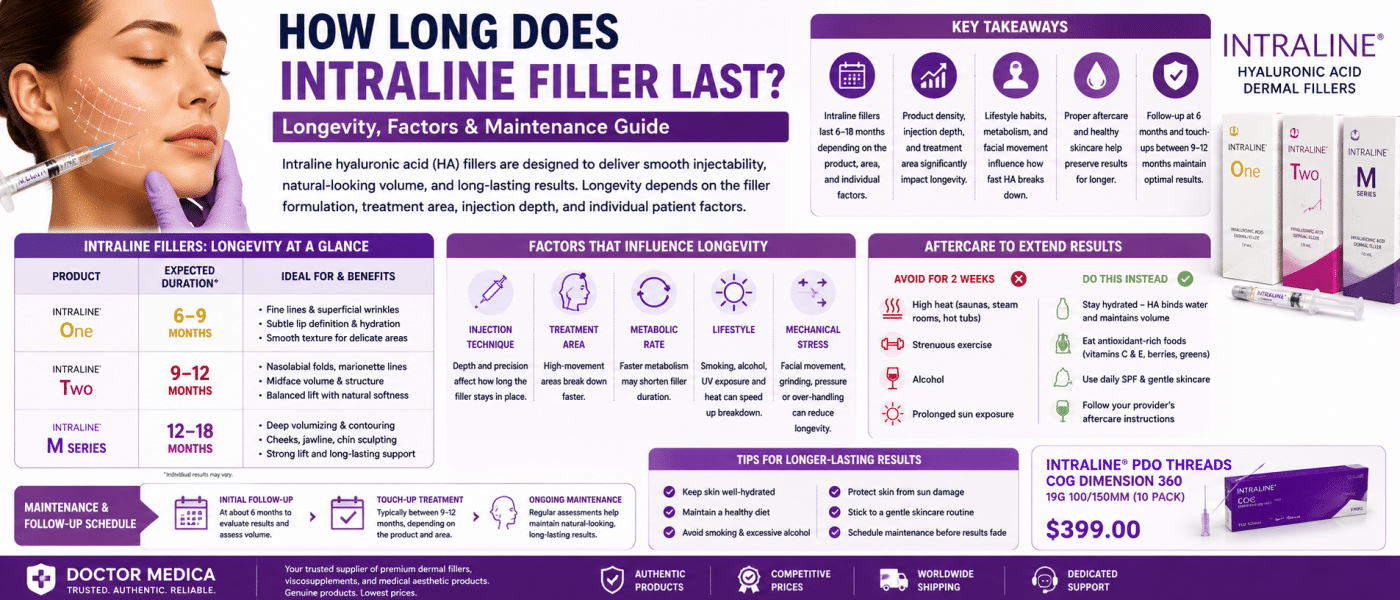
While some HA fillers may provide visible correction for approximately 6 to 18 months, the actual duration can vary substantially between patients and products. Research using imaging techniques has also demonstrated that HA filler material may sometimes remain detectable considerably longer than the period during which its visible aesthetic effect is most apparent.
Understanding how long Intraline filler may last can help practitioners set realistic expectations and develop individualized maintenance plans.
Key Takeaways
Intraline is an HA-based dermal filler range designed for different aesthetic applications and tissue depths.
The duration of filler results varies according to the specific product, treatment area, injection technique, volume injected, and individual patient factors.
Fillers placed in areas with frequent movement, such as the lips and perioral region, may require maintenance sooner than fillers used for structural facial contouring.
Product characteristics such as HA concentration, cross-linking, particle structure, and rheological properties can influence clinical performance.
Lifestyle, metabolism, facial movement, skin quality, and previous filler treatments may also affect how long results remain visible.
A follow-up appointment allows the practitioner to assess the treatment result and determine whether additional treatment is appropriate.
Patients should not assume that a filler needs to be replaced according to a fixed schedule; maintenance should be based on clinical assessment and the individual’s aesthetic goals.
About: Doctor Medica is a trusted supplier of dermal fillers, viscosupplements, and other medical and aesthetic products for professional practices. Contact Doctor Medica for information about product availability, ordering, and professional-use requirements.
Recommended Intraline Products
INTRALINE® M4 PLUS
A hyaluronic acid-based aesthetic product designed for professional use in accordance with the applicable product instructions and regulatory requirements.
INTRALINE® Product Range
Intraline offers different formulations intended to address varying aesthetic requirements. Product selection should be based on the treatment area, desired correction, tissue characteristics, and the practitioner’s clinical assessment.
Understanding Intraline Filler Longevity
The question “How long does Intraline filler last?” does not have one universal answer.
Dermal filler longevity is influenced by the interaction between the product and the patient’s tissue. Different formulations may have different rheological properties, concentrations, particle structures, and degrees of cross-linking.
These characteristics can influence how the filler behaves after injection and how long the aesthetic correction remains noticeable.
A useful way to think about longevity is not simply how long HA remains physically detectable, but how long the product continues to provide the desired clinical result.
For example, a filler may still be present within tissue after the patient begins noticing a gradual reduction in volume or contour definition.
Estimated Duration by Treatment Type
The expected duration should always be confirmed using the manufacturer’s current product information, as formulations and approved indications can vary.
Treatment consideration Typical expectation
Superficial correction Often shorter-lasting
Lip and perioral areas Frequently require earlier maintenance
Nasolabial and facial folds Variable, depending on product and technique
Cheek augmentation Often longer-lasting than highly mobile areas
Chin and jawline contouring May provide longer structural support
Individual metabolism Can significantly affect longevity
These ranges should be viewed as general clinical expectations rather than guarantees.
Factors That Affect How Long Intraline Lasts
Several factors can influence how quickly an HA filler loses its visible effect.
1. Product Formulation
Not all HA fillers are formulated in the same way.
Differences in:
HA concentration
Cross-linking technology
Particle size
Elasticity
Viscosity
Cohesivity
Water-binding characteristics
can influence how a filler integrates into tissue and how it performs in different anatomical areas.
For this reason, the expected longevity of one Intraline formulation should not automatically be applied to every product within the range.
2. Treatment Area
The location of the injection is one of the most important factors affecting perceived longevity.
Areas that experience substantial repetitive movement may show changes in filler volume or correction sooner.
Examples include:
Lips
Perioral area
Areas around the mouth
Highly expressive facial regions
By comparison, relatively stable structural areas such as the cheeks, chin, and jawline may maintain contour for longer in some patients.
3. Injection Depth
The anatomical plane in which a filler is placed can influence its clinical performance.
Superficial treatments designed for fine lines and skin-quality enhancement may behave differently from products placed deeper for structural support or volume restoration.
Proper product selection and placement are therefore essential for achieving an appropriate and predictable result.
4. Amount of Product Used
The amount of filler injected can affect the initial degree of correction and how long the result remains visibly noticeable.
However, using a larger amount of filler does not necessarily mean that the product will last proportionally longer.
A qualified practitioner should determine the appropriate volume based on anatomy, treatment objectives, and product characteristics.
5. Individual Metabolism
Patients process injectable materials differently.
Differences in metabolism, tissue remodeling, age, skin characteristics, and individual biology can contribute to variation in filler longevity.
Two patients receiving the same product in the same treatment area may therefore experience different durations of visible correction.
Lifestyle and Facial Movement
Lifestyle factors may also influence the appearance and persistence of aesthetic results.
Frequent facial movement, high levels of physical activity, smoking, sun exposure, and overall skin health can influence the condition of the surrounding tissue.
However, patients should be cautious about claims that specific lifestyle changes can guarantee longer filler longevity. Evidence for many commonly promoted aftercare practices is limited.
The most important approach is to follow the practitioner’s individualized post-treatment instructions and maintain good overall skin health.
How to Care for Skin After Intraline Treatment
Appropriate aftercare can help minimize temporary swelling and bruising and support a smooth recovery.
Immediately following treatment, practitioners may advise patients to:
Avoid unnecessary pressure or manipulation of the treated area.
Follow the specific activity restrictions provided by the injector.
Avoid excessive heat exposure when recommended by the practitioner.
Protect the skin from excessive sun exposure.
Maintain a gentle skincare routine.
Avoid introducing potentially irritating cosmetic procedures until the treated area has recovered.
Attend the recommended follow-up appointment.
Patients should not massage or manipulate a filler unless specifically instructed to do so by their healthcare provider.
Does Hydration Make Intraline Last Longer?
Because hyaluronic acid has strong water-binding properties, patients often ask whether drinking more water can extend filler longevity.
Maintaining normal hydration is beneficial for overall skin health, but there is no reliable evidence that simply drinking additional water substantially extends the lifespan of an HA filler.
Hydration can support healthy skin appearance, but it should not be presented as a method for preventing normal filler degradation.
When Should Intraline Filler Be Repeated?
There is no universal reinjection date that applies to every patient.
Instead, maintenance should be considered when the original aesthetic correction has decreased enough that the patient and practitioner agree that additional treatment is appropriate.
A follow-up consultation can evaluate:
Remaining volume
Facial symmetry
Skin quality
Degree of correction
Patient satisfaction
Changes in facial anatomy
Whether additional filler is actually necessary
In some cases, waiting until the result has partially diminished may be preferable to automatically scheduling injections at a predetermined interval.
Signs That It May Be Time for Maintenance
Patients may notice gradual changes such as:
Reduced facial volume
Less-defined contours
Returning facial folds
Decreased lip fullness
Reduced chin or jawline definition
Increasing asymmetry
These changes do not necessarily mean that the filler has completely disappeared.
A professional assessment can determine whether additional treatment would improve the result or whether another aesthetic approach may be more appropriate.
Can Intraline Filler Last Longer Than Expected?
Yes. Individual experiences can differ considerably.
Some patients may notice visible correction for longer than the commonly quoted duration, particularly when the filler is used in relatively stable anatomical areas.
At the same time, another patient may experience a shorter duration because of treatment location, individual biology, product selection, or other factors.
Importantly, detectable HA is not necessarily equivalent to a visible aesthetic effect. Imaging studies have reported persistence of HA filler material beyond the period during which patients perceive the original correction, demonstrating why longevity estimates should be interpreted carefully.
Intraline Filler and Combination Treatments
Patients sometimes consider combining HA fillers with other aesthetic procedures, such as neuromodulators, skin treatments, or collagen-stimulating procedures.
Combination treatments should be planned according to the patient’s anatomy and treatment goals.
For example, a neuromodulator may reduce excessive muscle activity, while an HA filler can restore volume or provide structural support. These treatments have different mechanisms and should not be considered interchangeable.
The timing and combination of procedures should be determined by an appropriately trained healthcare professional.
How Practitioners Can Improve Treatment Planning
For clinicians, maximizing the quality and predictability of filler results begins with appropriate patient assessment.
Important considerations include:
Evaluate facial anatomy carefully.
Choose a formulation appropriate for the treatment area.
Use an appropriate injection plane and technique.
Set realistic expectations regarding longevity.
Avoid promising a fixed duration of results.
Schedule follow-up based on individual response.
Document the product, lot information, treatment area, and amount used.
Reassess the patient’s needs before performing maintenance treatment.
A conservative, individualized approach can help achieve natural-looking results while avoiding unnecessary product use.
Conclusion: How Long Does Intraline Filler Last?
Intraline filler longevity varies from patient to patient and depends heavily on the specific formulation, treatment area, injection technique, and individual response.
While HA fillers commonly provide visible results for several months and some formulations may last considerably longer, there is no single duration that applies to every Intraline treatment.
Patients should focus less on a predetermined expiration date and more on the quality of the aesthetic result, their individual response, and professional follow-up.
For practitioners, careful product selection, appropriate injection technique, realistic patient counseling, and individualized maintenance planning are key to achieving consistent and natural-looking outcomes.