Botulinum toxin type A has become one of the most widely used injectable treatments in aesthetic medicine. By temporarily reducing muscle activity, botulinum toxin can soften dynamic facial lines and create a smoother, more refreshed appearance without surgery.
Among the products used in aesthetic practice, Botulax and Meditoxin are two South Korean botulinum toxin type A formulations that have attracted considerable attention from clinicians. Although both are designed to produce temporary muscle relaxation, they can differ in formulation, presentation, handling requirements, regulatory status, market availability, and clinical characteristics.
For healthcare professionals considering these products, understanding the similarities and differences between Botulax and Meditoxin is important for selecting an appropriate treatment option for each patient and treatment area.
This article compares the two products across formulation, onset, duration, handling, safety considerations, and practical use in aesthetic medicine.
Key Takeaways
Botulax and Meditoxin are botulinum toxin type A products intended to temporarily reduce muscle activity.
Their formulations, presentations, manufacturing characteristics, and regulatory approvals can differ between markets.
Botulax is supplied as a lyophilized product, meaning it requires reconstitution before administration according to the manufacturer’s instructions.
Meditoxin is another botulinum toxin type A formulation manufactured by Medytox and is marketed under different names in certain countries.
The onset and duration of treatment can vary considerably between individuals and treatment areas; product-to-product comparisons should not be interpreted as guaranteed clinical outcomes.
Common adverse effects associated with botulinum toxin injections may include temporary injection-site pain, swelling, bruising, headache, or localized muscle weakness.
Product units are not universally interchangeable between different botulinum toxin brands. Clinicians should follow the specific prescribing information and dosing guidance applicable to the product being used.
The choice between Botulax and Meditoxin should take into account regulatory approval, product authenticity, clinician experience, patient characteristics, treatment goals, and local availability.
About: Doctor Medica is a trusted supplier of medical and aesthetic products for professional practices. For information about product availability, ordering, and professional-use requirements, contact Doctor Medica directly.
Botulax and Meditoxin: Product Overview
Both Botulax and Meditoxin belong to the broader category of botulinum toxin type A injectables. Their primary pharmacological effect is based on temporarily inhibiting the release of acetylcholine at the neuromuscular junction.
As a result, treated muscles become less active, which can reduce the appearance of dynamic wrinkles and can also have therapeutic applications depending on the product’s approved indications.
However, the fact that two products contain botulinum toxin type A does not mean they are identical.
Manufacturing processes, excipients, complexing proteins, vial presentation, potency characteristics, and approved indications may differ. These differences are important considerations for healthcare professionals.
Botulax
Botulax, manufactured by Hugel, is a botulinum toxin type A product used in various markets for aesthetic and medical applications.
It is generally supplied as a freeze-dried powder, which must be reconstituted with an appropriate diluent before administration.
For clinicians, this format provides flexibility in preparing the product according to the treatment protocol. However, reconstitution requires careful handling, accurate dilution, appropriate storage, and adherence to the manufacturer’s instructions.
Botulax has gained recognition in international aesthetic markets and is commonly associated with treatments targeting dynamic facial lines.
Meditoxin
Meditoxin, manufactured by Medytox, is another botulinum toxin type A formulation. In some markets, the product is known under alternative brand names, including Neuronox.
Its formulation and presentation differ from Botulax, and the exact product characteristics can vary according to the market in which it is approved.
Meditoxin has been used in both aesthetic and therapeutic settings, with applications involving temporary muscle relaxation.
As with any botulinum toxin, clinicians should use the product according to its local regulatory authorization rather than assuming that indications approved in one country automatically apply elsewhere.
Botulax vs Meditoxin: Formulation and Handling
One of the practical differences clinicians may encounter when comparing botulinum toxin products is their presentation and reconstitution requirements.
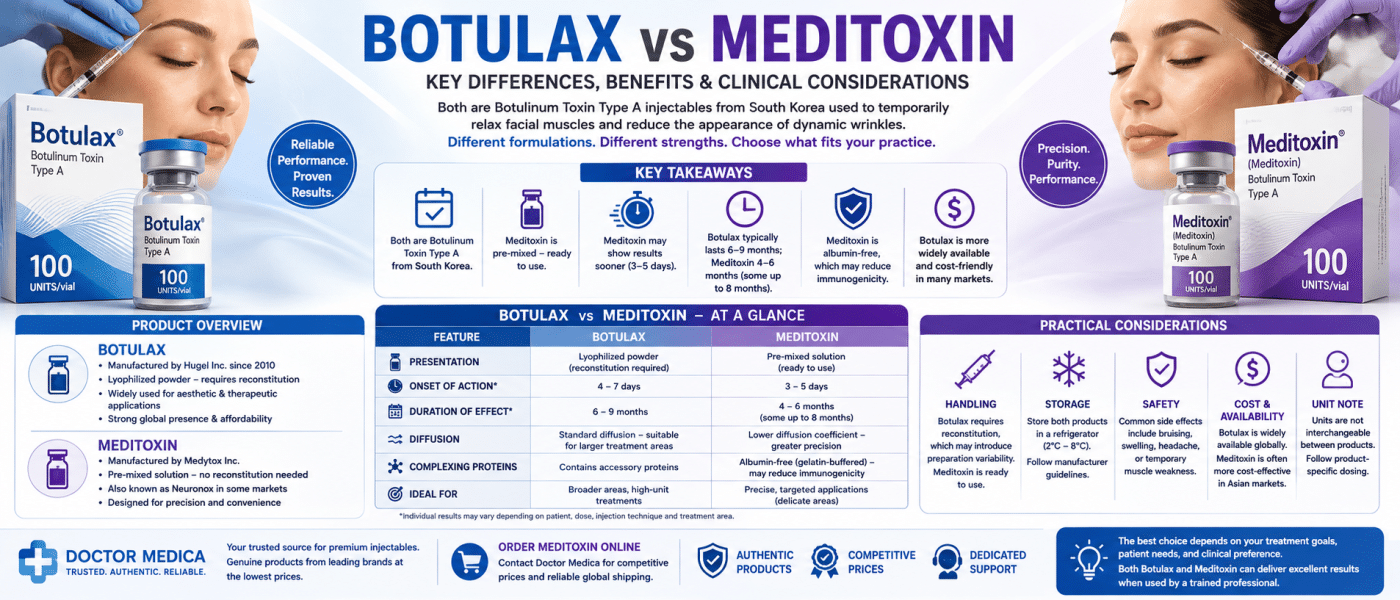
Feature Botulax Meditoxin
Toxin type Botulinum toxin type A Botulinum toxin type A
Manufacturer Hugel Medytox
Typical presentation Lyophilized powder Product presentation varies by market
Reconstitution Required before administration Follow local product instructions
Primary effect Temporary muscle relaxation Temporary muscle relaxation
Aesthetic use Dynamic facial lines Dynamic facial lines
Unit interchangeability Not directly interchangeable with other brands Not directly interchangeable with other brands
The exact vial size, formulation, excipients, approved indications, storage requirements, and preparation instructions should always be confirmed using the current product information for the specific market.
Mechanism of Action
Botulax and Meditoxin work through the same fundamental pharmacological pathway.
Following injection into the targeted muscle, botulinum toxin type A interferes with acetylcholine release at the neuromuscular junction. This temporarily decreases muscle contraction.
In aesthetic medicine, reduced contraction can soften dynamic wrinkles associated with repetitive facial movements.
Common treatment areas may include:
Glabellar lines
Forehead lines
Crow’s feet
Other selected areas of dynamic facial movement
Treatment selection and injection technique should be individualized according to the patient’s anatomy, muscle activity, facial proportions, and desired outcome.
Onset of Results
Patients do not generally see the complete effect immediately following a botulinum toxin injection.
The onset of muscle relaxation typically develops progressively over the first several days, with the final result generally assessed later according to the product and treatment protocol.
Claims that one brand is universally faster than another should be interpreted cautiously. Individual response can vary, and factors such as injection technique, muscle strength, dose, treatment area, and previous exposure to botulinum toxin may influence the observed result.
For this reason, clinicians should evaluate efficacy based on appropriate clinical follow-up rather than relying solely on generalized onset timelines.
Duration of Effect
The effects of botulinum toxin are temporary.
The duration of muscle relaxation can differ according to:
Treatment area
Dose
Muscle size and activity
Individual metabolism
Injection technique
Previous treatment history
Patient-specific response
Although aesthetic effects commonly last for several months, there is considerable individual variation.
It is therefore preferable to discuss duration as an expected treatment range rather than a guaranteed number of months.
Safety and Potential Side Effects
Botulax and Meditoxin share many of the potential adverse effects associated with botulinum toxin injections.
Common temporary reactions can include:
Injection-site pain
Redness
Swelling
Bruising
Headache
Temporary tenderness
Localized muscle weakness
In aesthetic treatments, unwanted muscle weakness can occasionally affect nearby muscles and may result in effects such as temporary eyelid or eyebrow asymmetry.
More serious adverse reactions are uncommon but can occur. Patients should be appropriately screened and informed about potential risks before treatment.
Healthcare professionals should also be familiar with contraindications, precautions, potential interactions, and the specific safety information provided for the selected product.
Why Unit Conversion Matters
One of the most important considerations when comparing botulinum toxin brands is potency measurement.
Botulinum toxin units are product-specific and should not automatically be treated as equivalent across brands.
Therefore, clinicians should not simply convert the number of units used for one product into the same number for another product without appropriate evidence and manufacturer guidance.
Instead, dosing should be based on:
The specific product being administered.
Its approved prescribing information.
The treatment indication.
The anatomical area.
The patient’s individual characteristics.
The clinician’s training and experience.
This distinction is particularly important when switching between different botulinum toxin formulations.
Diffusion and Injection Precision
The clinical outcome of botulinum toxin treatment depends on considerably more than the intrinsic properties of a product.
Injection depth, dose, dilution, needle placement, muscle anatomy, and injection technique can all influence how the toxin affects surrounding tissue.
For delicate facial areas, precise anatomical knowledge is particularly important. Excessive dosing or inaccurate placement can increase the likelihood of unwanted muscle weakness or asymmetry.
Rather than assuming that one formulation will always remain more localized than another, clinicians should consider the complete treatment protocol and the individual anatomy of the patient.
Storage and Professional Handling
Botulinum toxin products are temperature-sensitive biological products and must be handled according to their specific manufacturer’s storage requirements.
Clinics should maintain appropriate storage conditions throughout the product’s lifecycle, from delivery through preparation and administration.
Important considerations include:
Maintaining the recommended temperature range.
Protecting the product from inappropriate handling.
Following the manufacturer’s reconstitution instructions.
Using the recommended diluent.
Observing the applicable post-reconstitution storage and use period.
Maintaining appropriate infection-control procedures.
These steps are essential for maintaining product quality and patient safety.
Which Is Better: Botulax or Meditoxin?
There is no universal answer to whether Botulax or Meditoxin is the better option.
The most appropriate product depends on the clinician, patient, treatment area, regulatory environment, product availability, and clinical objective.
Botulax may be attractive to practices that are familiar with its formulation and preparation process, while Meditoxin may be preferred by clinicians who have experience with its specific formulation and approved indications.
Instead of selecting a product solely on claims of faster onset or longer duration, healthcare professionals should consider the total clinical picture and the quality of available evidence.
Choosing a Product for Aesthetic Practice
When evaluating Botulax and Meditoxin, clinics should consider several factors:
1. Regulatory Approval
The product should be legally authorized for its intended use in the country where treatment is provided.
2. Product Authenticity
Purchasing from a reliable professional supplier is important for reducing the risk of counterfeit or improperly stored products.
3. Clinician Experience
Familiarity with a specific botulinum toxin formulation can contribute to consistent preparation and treatment planning.
4. Patient Goals
Treatment should be tailored to the patient’s expectations, facial anatomy, and desired degree of muscle relaxation.
5. Cost and Availability
Pricing, supply continuity, and local availability may influence product selection, particularly for high-volume aesthetic practices.
Conclusion
Botulax and Meditoxin are both botulinum toxin type A products used for temporary muscle relaxation, including applications in aesthetic medicine. While they share the same fundamental mechanism of action, differences in formulation, presentation, manufacturing, regulatory status, and market availability can influence how clinicians use and evaluate them.
Neither product should automatically be considered superior in every clinical situation. Treatment outcomes depend on multiple factors, including patient anatomy, dose, injection technique, treatment area, and practitioner experience.
For healthcare professionals, the most important considerations are product authenticity, regulatory compliance, appropriate dosing, correct handling, patient selection, and evidence-based treatment planning.
Ultimately, Botulax vs Meditoxin should be viewed as a clinical and practical comparison rather than a simple question of which product is universally better. A qualified healthcare professional should determine the most appropriate option for each patient and indication.