Osteoporosis affects more than 200 million people worldwide and remains one of the leading causes of fractures among older adults. As bone density declines, the risk of debilitating hip, spine, and wrist fractures increases significantly, making timely and effective treatment essential. While lifestyle changes and calcium supplementation play an important role in bone health, many patients require prescription therapies to reduce fracture risk and preserve long-term mobility.
Among today’s most advanced osteoporosis medications are Evenity® (romosozumab-aqqg) and Prolia® (denosumab). Both injectable biologic therapies improve bone strength, yet they work through entirely different mechanisms. Evenity acts as an anabolic agent that stimulates new bone formation while reducing bone breakdown, whereas Prolia is an antiresorptive therapy that primarily slows bone loss by inhibiting osteoclast activity.
In this guide, we’ll compare Evenity and Prolia, examine how each medication works, discuss their benefits, safety profiles, dosing schedules, and explain why sequential therapy has become a preferred strategy for many patients at high risk of fractures.
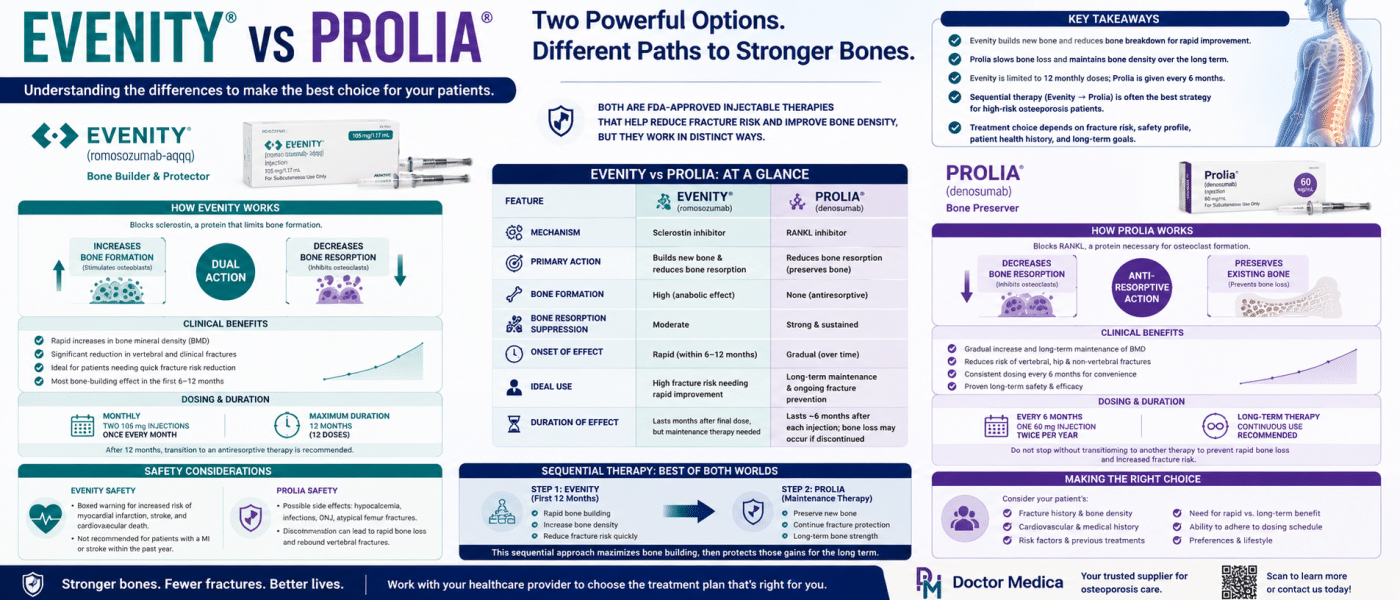
Key Takeaways
Evenity stimulates both bone formation and reduces bone resorption, producing rapid improvements in bone mineral density.
Prolia primarily prevents bone loss by inhibiting osteoclast activity, making it ideal for long-term maintenance therapy.
Evenity treatment is limited to 12 monthly doses, while Prolia may be continued for several years with regular monitoring.
Sequential therapy—starting with Evenity followed by Prolia—often provides the greatest long-term fracture protection.
Individual treatment selection depends on fracture risk, cardiovascular history, bone density, and patient adherence.
Understanding Osteoporosis Treatment
Healthy bone constantly undergoes remodeling through two opposing processes:
Bone formation by osteoblasts
Bone resorption by osteoclasts
Osteoporosis develops when bone resorption exceeds bone formation, resulting in progressively weaker bones.
Modern osteoporosis medications target these biological pathways differently, which explains why Evenity and Prolia serve different roles in treatment.
What Is Evenity?
Evenity (romosozumab-aqqg) is a monoclonal antibody that blocks sclerostin, a protein responsible for limiting bone formation.
By inhibiting sclerostin, Evenity:
Stimulates new bone growth
Reduces bone resorption
Rapidly increases bone mineral density
Significantly lowers vertebral fracture risk
This dual-action mechanism makes Evenity one of the few medications capable of actively rebuilding bone.
What Is Prolia?
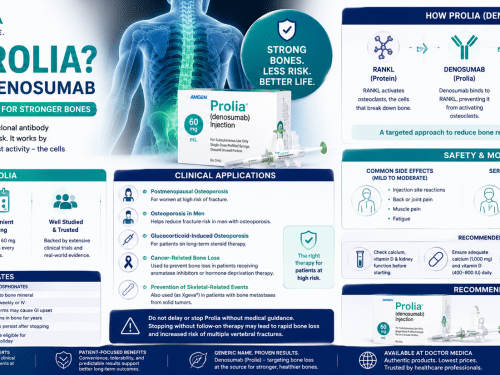
Prolia (denosumab) is also a monoclonal antibody, but it targets an entirely different pathway.
Prolia blocks RANKL (Receptor Activator of Nuclear Factor Kappa-B Ligand), a signaling protein necessary for osteoclast formation.
By preventing osteoclast activation, Prolia:
Reduces bone breakdown
Preserves existing bone
Gradually increases bone density
Lowers vertebral, hip, and non-vertebral fracture risk
Unlike Evenity, Prolia does not directly stimulate new bone formation.
Mechanism of Action Comparison
Feature Evenity Prolia
Primary Target Sclerostin RANKL
Bone Formation Significantly increased No direct stimulation
Bone Resorption Reduced Strongly reduced
Overall Effect Builds new bone and protects existing bone Prevents bone loss
Treatment Goal Rapid bone rebuilding Long-term bone preservation
These differences explain why physicians often prescribe the medications at different stages of osteoporosis management.
Benefits of Evenity
Evenity offers several important clinical advantages.
Rapid Bone Density Improvement
Bone mineral density often increases significantly during the first year of therapy.
Dual Mechanism
Few osteoporosis medications both stimulate bone formation and reduce bone breakdown simultaneously.
Reduced Fracture Risk
Clinical studies demonstrate meaningful reductions in vertebral and clinical fractures within the first year.
Ideal for High-Risk Patients
Evenity is particularly useful for patients with:
Recent fragility fractures
Severe osteoporosis
Very low T-scores
High imminent fracture risk
Benefits of Prolia
Prolia has become one of the most widely prescribed long-term osteoporosis therapies.
Its benefits include:
Continuous Bone Protection
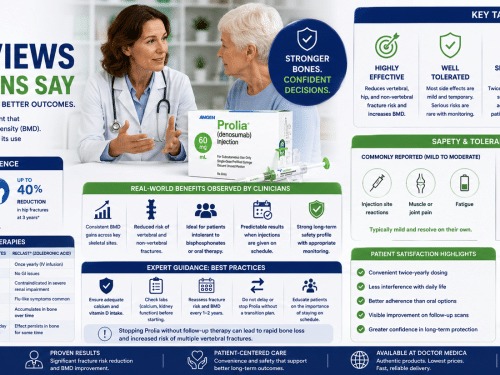
Prolia suppresses bone resorption for six months after each injection.
Long-Term Fracture Prevention
Consistent treatment reduces vertebral, hip, and non-vertebral fractures.
Convenient Dosing
Only one injection every six months improves treatment adherence.
Suitable Maintenance Therapy
Many patients continue Prolia for several years following anabolic treatment.
Dosing Schedule Comparison
Evenity
Two injections administered once monthly
Maximum treatment duration: 12 months
Intended as an initial anabolic therapy
Prolia
One injection every six months
Long-term therapy
Requires continuous administration or carefully planned transition to another antiresorptive medication
Safety Considerations
Both medications have well-established safety profiles, but important differences exist.
Evenity Safety
Healthcare providers should evaluate cardiovascular history before initiating treatment.
Evenity carries a boxed warning regarding:
Heart attack
Stroke
Cardiovascular death
It is generally avoided in patients who experienced a myocardial infarction or stroke within the previous year.
Prolia Safety
Prolia does not carry the same cardiovascular warning but requires consistent long-term use.
Potential concerns include:
Hypocalcemia
Rare osteonecrosis of the jaw
Atypical femur fractures
Rapid bone loss after discontinuation
Increased vertebral fracture risk if therapy is stopped without follow-up treatment
Why Sequential Therapy Is Often Recommended
Current clinical practice increasingly favors sequential therapy for patients with severe osteoporosis.
The typical sequence is:
Phase 1: Evenity
Builds new bone rapidly
Restores skeletal strength
Lasts 12 months
Phase 2: Prolia
Preserves newly formed bone
Continues fracture protection
Maintains bone mineral density
This combination maximizes both bone formation and long-term maintenance.
Which Patients Benefit Most from Evenity?
Evenity may be preferred for patients who have:
Multiple fragility fractures
Very low bone mineral density
High fracture risk
Failure of previous osteoporosis therapies
Need for rapid skeletal improvement
Which Patients Benefit Most from Prolia?
Prolia is often recommended for patients requiring:
Long-term osteoporosis management
Ongoing fracture prevention
Maintenance after anabolic therapy
Treatment intolerance to bisphosphonates
Factors to Consider When Choosing Treatment
Healthcare providers typically evaluate:
Age
Bone mineral density
Previous fractures
Cardiovascular history
Kidney function
Fall risk
Treatment adherence
Patient preferences
Personalized treatment plans generally produce the best long-term outcomes.
Conclusion
Evenity and Prolia are both highly effective biologic therapies for osteoporosis, but they fulfill different roles within modern treatment strategies. Evenity offers rapid bone rebuilding through its unique dual-action mechanism, making it particularly valuable for patients at very high fracture risk. Prolia, on the other hand, excels at preserving bone mass over the long term by suppressing bone resorption.