Osteoporosis is a progressive condition that weakens bones and increases the risk of fractures, particularly in older adults. As life expectancy continues to rise, effective treatments that can slow bone loss, preserve bone mineral density (BMD), and reduce fracture risk have become an important part of long-term healthcare.
One treatment that has gained widespread attention is Prolia, a prescription medication designed to reduce excessive bone resorption. Unlike traditional bisphosphonates, Prolia belongs to a class of biologic medicines known as monoclonal antibodies. Its active ingredient is denosumab, which works by targeting a key signaling protein involved in osteoclast activity.
Understanding the Prolia generic name, mechanism of action, clinical uses, and safety considerations can help patients and healthcare professionals make more informed decisions about osteoporosis management.
Key Takeaways
Denosumab is the active ingredient in Prolia, a monoclonal antibody used to reduce bone loss and fracture risk in appropriate patients.
Prolia works by targeting RANK ligand (RANKL), a protein essential for the formation and activity of osteoclasts.
The treatment is administered as a subcutaneous injection once every six months, making it a convenient option for long-term osteoporosis management.
Denosumab can significantly increase bone mineral density and reduce the risk of vertebral, non-vertebral, and hip fractures in appropriate high-risk patients.
Denosumab is also used in other clinical settings under different brand names, including prevention of skeletal-related events associated with certain cancers.
Calcium and vitamin D status should be adequately maintained, and patients at increased risk of hypocalcemia require appropriate monitoring.
Healthcare professionals should carefully plan any interruption or discontinuation of Prolia because stopping treatment without follow-on antiresorptive therapy can result in rapid bone loss and an increased risk of vertebral fractures.
Appropriate patient selection, regular follow-up, and adherence to the six-month dosing schedule are essential for safe and effective treatment.
About: Doctor Medica is your trusted supplier of top-quality dermal fillers, viscosupplements, and medical products for professional use. We offer authentic products from leading brands at competitive prices. Contact Doctor Medica to explore Prolia for your practice.
Recommended Product
PROLIA® (Denosumab)
Considering a Purchase?
Sign In to Explore Options.
What Is the Prolia Generic Name?
The generic name for Prolia is denosumab. Prolia is the brand name used for denosumab when prescribed for specific bone-loss conditions, including osteoporosis.
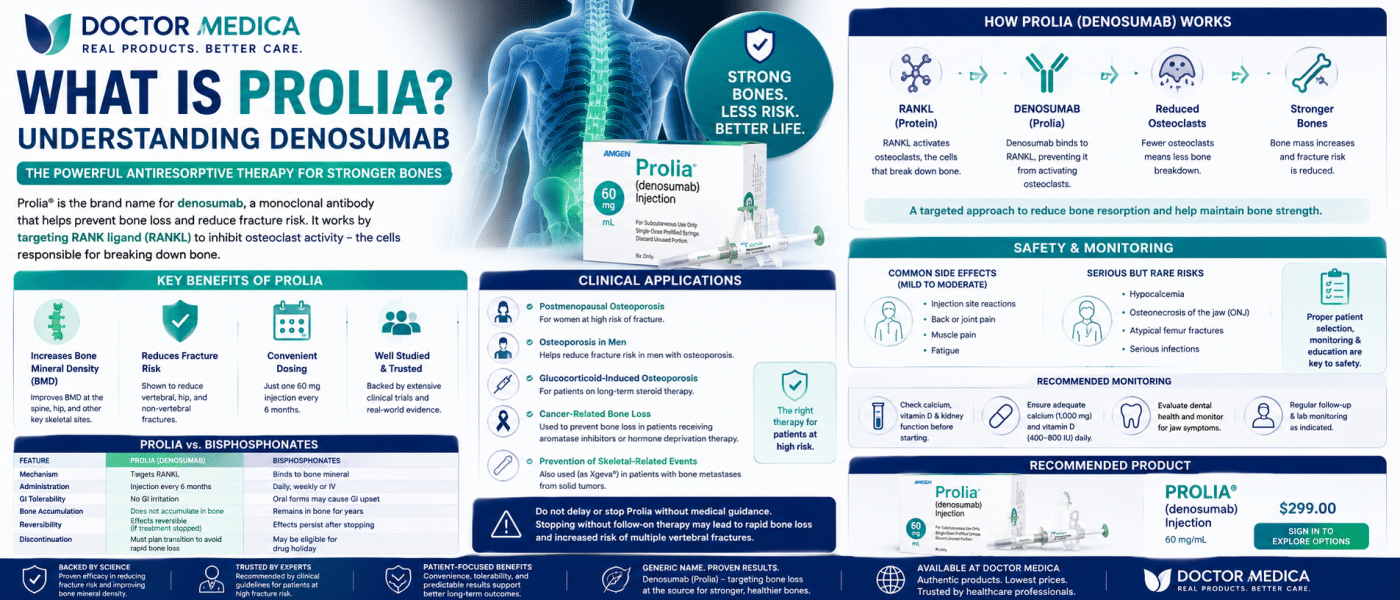
Denosumab is a fully human monoclonal antibody that selectively binds to RANKL (receptor activator of nuclear factor kappa-B ligand). RANKL plays an essential role in the development, activation, and survival of osteoclasts—the cells responsible for breaking down bone tissue.
By blocking RANKL, denosumab reduces osteoclast formation and activity. This decreases bone resorption, allowing bone mineral density to increase and helping reduce fracture risk.
Unlike bisphosphonates, which can remain incorporated in bone for extended periods, denosumab’s effects are reversible after treatment is stopped. This characteristic makes treatment continuity and appropriate transition planning particularly important.
How Does Denosumab Work in the Body?
Healthy bones are continuously remodeled through a balance between two primary cell types:
Osteoclasts, which break down older bone tissue.
Osteoblasts, which help build new bone.
With osteoporosis, bone resorption can exceed bone formation, gradually reducing bone strength and increasing fracture susceptibility.
Denosumab interrupts this process by blocking the RANKL signaling pathway. As a result, osteoclast activity is substantially reduced.
This mechanism can lead to several important effects:
Reduced Bone Resorption
By limiting osteoclast activity, denosumab slows the breakdown of existing bone.
Improved Bone Mineral Density
Treatment can increase BMD at important skeletal sites, including the lumbar spine, hip, and other areas vulnerable to osteoporotic fractures.
Lower Fracture Risk
Clinical evidence demonstrates that denosumab can reduce the risk of vertebral, non-vertebral, and hip fractures in appropriate postmenopausal women with osteoporosis.
Convenient Administration
Prolia is given as a 60 mg subcutaneous injection every six months, which may be easier for some patients to maintain than daily, weekly, or monthly oral therapies.
Who May Benefit From Prolia?
Prolia may be prescribed for specific patients with osteoporosis who have a significant risk of fracture. It can be particularly relevant when other treatment options are unsuitable, ineffective, or poorly tolerated.
Depending on the patient’s medical circumstances, denosumab may be considered for:
Postmenopausal women with osteoporosis who are at high risk of fractures.
Men with osteoporosis who are at increased fracture risk.
Certain patients receiving glucocorticoid therapy who are at increased risk of osteoporosis-related fractures.
Patients experiencing bone loss associated with certain cancer treatments, when indicated.
The choice of therapy should always be based on an individual’s fracture risk, medical history, kidney function, previous treatments, and other relevant clinical factors.
Prolia vs. Traditional Osteoporosis Treatments
One of the distinguishing characteristics of Prolia is its biological mechanism.
Feature Prolia / Denosumab Bisphosphonates
Drug class Monoclonal antibody Antiresorptive agents
Primary target RANKL Bone mineral / osteoclast activity
Administration Subcutaneous injection every 6 months Oral or intravenous, depending on medication
Bone accumulation Does not accumulate in bone in the same way as bisphosphonates Can remain in bone for prolonged periods
GI considerations No oral gastrointestinal exposure Oral forms may cause GI irritation
Treatment interruption Requires careful transition planning Effects may persist after discontinuation
Main purpose Reduce bone resorption and fracture risk Reduce bone resorption and fracture risk
Neither approach is universally superior. Treatment selection should be individualized according to the patient’s clinical profile and treatment goals.
Clinical Applications Beyond Osteoporosis
The active ingredient denosumab is used in more than one therapeutic setting.
While Prolia is associated with osteoporosis and certain bone-loss indications, a different denosumab formulation and brand, Xgeva, is used in oncology for specific indications involving bone metastases and giant cell tumor of bone.
The distinction is important because the dose, treatment schedule, indication, and clinical context differ between products.
Healthcare professionals should therefore ensure that the appropriate denosumab product is selected for the specific indication.
Safety, Side Effects, and Monitoring
Like all prescription medications, Prolia has potential adverse effects. Most patients tolerate treatment well, but appropriate monitoring is particularly important for individuals with risk factors for complications.
Commonly Reported Reactions
Some patients may experience:
Musculoskeletal pain
Back or joint pain
Pain or reactions at the injection site
Fatigue
Certain skin reactions or infections
These effects are often manageable, but persistent or severe symptoms should be evaluated by a healthcare professional.
Important but Less Common Risks
Potential serious complications include:
Hypocalcemia, particularly in patients with advanced chronic kidney disease or other risk factors
Osteonecrosis of the jaw (ONJ)
Atypical femoral fractures
Serious infections in some patients
Patients should inform their healthcare provider about existing medical conditions, medications, dental problems, and other relevant risk factors before treatment.
Calcium, Vitamin D, and Patient Monitoring
Adequate calcium and vitamin D intake is an important component of Prolia therapy. Healthcare professionals should assess whether supplementation is appropriate for each patient and correct deficiencies when necessary.
Patients with advanced kidney disease, particularly those receiving dialysis, have a substantially increased risk of severe hypocalcemia with denosumab and require careful calcium management and monitoring.
Depending on the patient’s medical history, clinicians may evaluate:
Serum calcium
Vitamin D status
Kidney function
Existing fracture risk
Dental health
Other medications affecting calcium or bone metabolism
Regular follow-up helps identify potential complications early and supports continued treatment effectiveness.
Why Treatment Continuity Matters
One of the most important considerations with Prolia is what happens when treatment is delayed or discontinued.
Because denosumab strongly suppresses bone resorption, stopping treatment can be followed by a rapid increase in bone turnover. This may result in significant loss of BMD and an increased risk of multiple vertebral fractures.
For this reason, Prolia should not simply be discontinued without an appropriate medical plan. When treatment needs to end, healthcare professionals generally consider follow-on antiresorptive therapy to help preserve bone density and reduce the risk associated with rebound bone loss.
Patients should also avoid missing scheduled injections and should contact their healthcare provider if an injection cannot be administered on time.
Prolia Administration and Long-Term Management
Prolia is administered by a qualified healthcare professional as a subcutaneous injection every six months.
Long-term management may include:
Assessing fracture risk before and during treatment.
Maintaining adequate calcium and vitamin D intake.
Monitoring patients with risk factors for hypocalcemia.
Maintaining regular six-month dosing.
Monitoring bone mineral density when clinically appropriate.
Maintaining good oral and dental health.
Developing a treatment-transition strategy before discontinuation.
A personalized treatment plan allows healthcare professionals to balance the benefits of fracture prevention with individual risk factors.
Conclusion
The Prolia generic name, denosumab, represents an important development in modern osteoporosis treatment. By specifically targeting RANKL, denosumab suppresses osteoclast activity, reduces bone resorption, improves bone mineral density, and lowers fracture risk in appropriate high-risk patients.
Its twice-yearly administration can also provide a convenient alternative for patients who have difficulty with oral osteoporosis medications or cannot tolerate them.
However, Prolia requires careful long-term management. Maintaining adequate calcium and vitamin D levels, monitoring patients at increased risk of hypocalcemia, following the recommended dosing schedule, and planning appropriately before discontinuation are all essential aspects of treatment.
For patients and healthcare professionals considering osteoporosis therapies, understanding what denosumab is, how Prolia works, and why treatment continuity matters provides a valuable foundation for informed clinical decision-making.