Botulinum toxin type A products are widely used in aesthetic medicine to temporarily reduce dynamic wrinkles and in various therapeutic settings to manage excessive muscle activity. Although these products share the same fundamental mechanism of action, they can differ in formulation, manufacturing processes, regulatory status, approved indications, and clinical handling.
Meditoxin and Nabota are two botulinum toxin type A brands that have gained recognition in international markets. Both are designed to produce temporary muscle relaxation, making them useful for applications such as glabellar lines and other indications depending on the product’s local regulatory approval.
While their clinical effects can be broadly comparable, differences in product characteristics, available evidence, market authorization, pricing, and practitioner familiarity may influence product selection.
In this article, we’ll compare Meditoxin vs Nabota across formulation, mechanism of action, clinical performance, safety, dosing considerations, storage, and practical use.
Key Takeaways
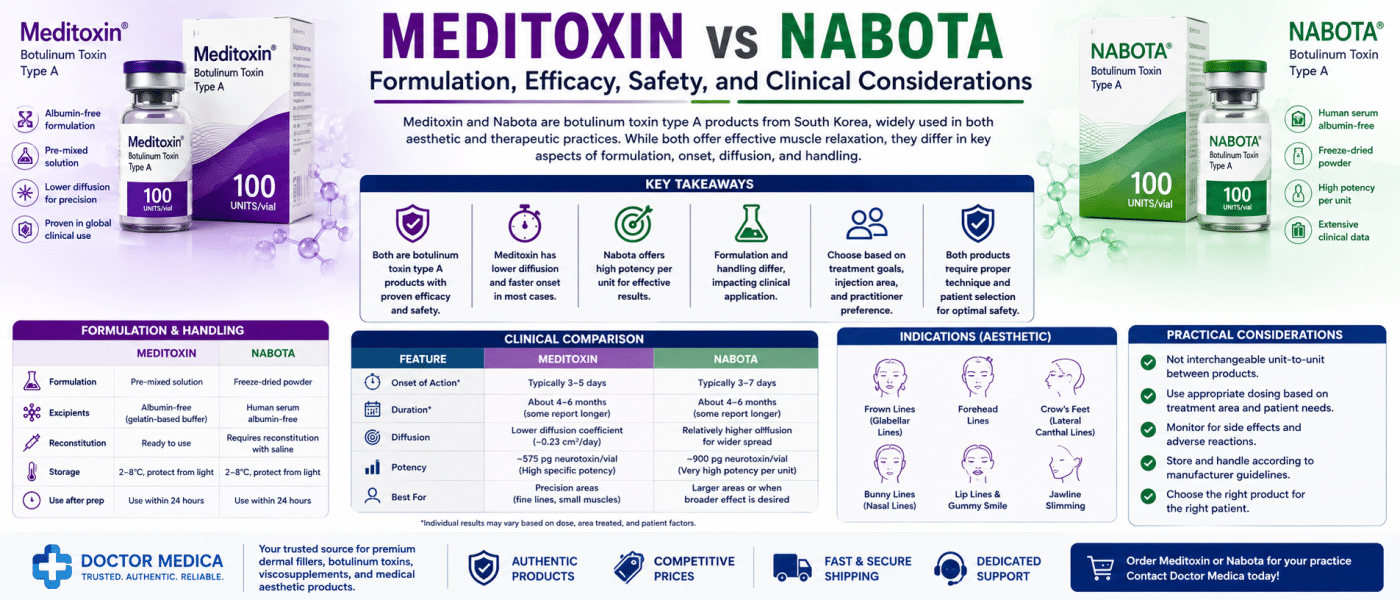
Meditoxin and Nabota are both botulinum toxin type A products that temporarily reduce muscle activity by inhibiting acetylcholine release at neuromuscular junctions.
Both can provide effective reduction of dynamic facial wrinkles when appropriately administered by qualified healthcare professionals.
Differences between the products include their manufacturing processes, formulation characteristics, regulatory approvals, clinical evidence, and market availability.
Neither product should be assumed to have a specific diffusion advantage solely from its molecular weight or complexing-protein profile; clinical spread depends on multiple factors, including dose, injection technique, anatomy, and dilution.
The effects of botulinum toxin are temporary, with duration varying according to treatment area, dose, individual response, and other patient-specific factors.
Common adverse effects may include injection-site discomfort, bruising, swelling, headache, or temporary muscle weakness. Rare complications such as eyelid or brow ptosis require appropriate clinical management.
Botulinum toxin units are product-specific and should not be converted between brands using an assumed one-to-one ratio unless supported by appropriate clinical and regulatory guidance.
Storage and reconstitution requirements should always follow the current product labeling and local prescribing information.
The choice between Meditoxin and Nabota should consider regulatory approval, indication, practitioner experience, patient anatomy, treatment goals, product availability, and cost.
Qualified practitioners should use only authentic, appropriately stored products obtained through authorized or reputable medical supply channels.
About: Doctor Medica is your trusted supplier of top-quality dermal fillers, viscosupplements, botulinum toxins, and other medical and aesthetic products for your practice. We offer authentic products from leading brands at competitive prices. Contact Doctor Medica today.
Meditoxin vs Nabota: Active Ingredient and Mechanism of Action
Both Meditoxin and Nabota contain botulinum neurotoxin type A (BoNT-A). Their therapeutic effect is based on the same fundamental biological mechanism: temporarily reducing communication between motor nerve endings and targeted muscles.
After injection, botulinum toxin acts at the neuromuscular junction by interfering with the release of acetylcholine, the neurotransmitter responsible for stimulating muscle contraction.
The result is temporary reduction in activity of the injected muscle.
This mechanism can help soften dynamic facial lines, particularly those produced by repetitive muscle contraction. Depending on the specific product and country of authorization, botulinum toxin type A may also be approved for a variety of therapeutic indications.
How the Products Work
Meditoxin: Contains botulinum toxin type A formulated for temporary inhibition of neuromuscular transmission.
Nabota: Also contains botulinum toxin type A and produces muscle relaxation through inhibition of acetylcholine release.
Clinical effect: Both products ultimately reduce activity in the targeted muscle rather than mechanically filling wrinkles.
Duration: The effect gradually wears off as neuromuscular function recovers.
The fundamental pharmacological mechanism is therefore similar, even though manufacturing and formulation characteristics may differ.
Formulation, Purification, and Molecular Characteristics
When comparing Meditoxin vs Nabota, it is important to distinguish between the active neurotoxin itself and the other components of the finished formulation.
Botulinum toxin products undergo extensive purification and manufacturing controls designed to produce a consistent biological preparation. Differences in manufacturing technology can influence characteristics such as protein composition, stability, and handling.
However, these differences should not automatically be interpreted as evidence that one product has universally superior diffusion, efficacy, or safety.
Meditoxin
Meditoxin is a commercially available botulinum toxin type A preparation manufactured by Medytox. Its formulation contains purified botulinum toxin type A together with excipients used to maintain product stability.
Its clinical use has expanded beyond its original Asian markets, although regulatory approvals and approved indications vary by country.
Nabota
Nabota is a botulinum toxin type A product manufactured by Daewoong Pharmaceutical. In the United States, the product is marketed as Jeuveau for specific aesthetic indications.
Nabota has been evaluated in clinical studies for aesthetic treatment and has established regulatory authorization in a number of markets.
Why Formulation Matters
For practitioners, relevant considerations include:
Manufacturing consistency
Protein and excipient composition
Product stability
Reconstitution characteristics
Regulatory approval
Available clinical evidence
Storage requirements
Practitioner familiarity
Rather than assuming that a particular formulation automatically produces greater precision or less diffusion, clinicians should consider the total clinical context, including injection technique and anatomy.
Meditoxin vs Nabota: Diffusion and Injection Precision
Diffusion is frequently discussed when comparing botulinum toxin products. However, it is more complicated than simply comparing molecular size or the presence of accessory proteins.
The clinical spread of botulinum toxin can be affected by:
Total dose administered
Injection volume
Dilution
Injection depth
Injection technique
Distance from the intended muscle
Local anatomy
Muscle size and activity
Individual patient characteristics
For this reason, claims that one brand has a universally “narrower” or “wider” diffusion profile should be interpreted cautiously.
Importance in Delicate Areas
Precision is particularly important when treating areas such as:
Glabellar lines
Crow’s feet
Forehead lines
Periorbital muscles
Brow depressor muscles
In these regions, inadvertent exposure of neighboring muscles can contribute to unwanted effects such as eyelid or brow ptosis.
The practitioner’s knowledge of facial anatomy and appropriate injection technique therefore plays a major role in treatment outcomes, regardless of the specific toxin selected.
Clinical Efficacy: Meditoxin vs Nabota
Clinical studies of botulinum toxin type A products generally demonstrate substantial reductions in dynamic facial wrinkles when appropriate doses are administered.
Both Meditoxin and Nabota have been investigated for aesthetic indications, and studies have reported meaningful improvements in wrinkle severity and patient satisfaction.
Onset of Action
Visible effects do not generally occur immediately after injection.
Patients may begin noticing changes within several days, with the full clinical effect developing over the following weeks. Individual responses vary according to the treatment area, dose, muscle strength, and patient characteristics.
Duration of Effect
Botulinum toxin effects are temporary.
Many patients experience aesthetic benefits for approximately 3–4 months, although the duration can vary considerably. Some individuals may experience longer-lasting effects, while others may require retreatment sooner.
Duration should therefore not be presented as a fixed characteristic of either Meditoxin or Nabota.
Treatment Results
Successful treatment aims to achieve:
Reduced muscle contraction
Softer dynamic wrinkles
Preservation of natural facial expression
Balanced facial movement
Patient satisfaction with the aesthetic result
The quality of the outcome depends not only on the product but also on patient selection, dose, injection pattern, anatomy, and practitioner expertise.
Safety Profile and Potential Adverse Effects
Like other botulinum toxin products, Meditoxin and Nabota can cause adverse reactions.
Most treatment-related effects are temporary and localized, although serious complications are possible and require appropriate medical management.
Common Reactions
Potential effects include:
Injection-site pain or tenderness
Bruising
Redness
Swelling
Headache
Temporary muscle weakness
Facial asymmetry
Temporary eyelid or brow ptosis
These reactions generally resolve as the effects of the treatment wear off.
Rare or Significant Complications
Rarely, botulinum toxin effects can extend beyond the intended treatment area. Depending on the indication and clinical circumstances, symptoms may include:
Significant muscle weakness
Difficulty swallowing
Speech difficulties
Breathing difficulties
Generalized weakness
Patients experiencing serious or unexpected symptoms after treatment should seek prompt medical evaluation.
Appropriate patient screening, accurate dosing, anatomical knowledge, sterile technique, and adherence to product labeling are essential components of safe treatment.
Meditoxin vs Nabota: Unit Equivalency and Dosing
One of the most important considerations when comparing botulinum toxin brands is unit potency.
Although different products may all be labeled in “units,” their biological potency assays are product-specific. Therefore, one unit of Meditoxin should not automatically be assumed to equal one unit of Nabota or another botulinum toxin product.
There is no universal conversion ratio that can safely be applied across all botulinum toxin brands and indications.
Practitioners should therefore:
Follow the relevant product labeling.
Use product-specific dosing recommendations.
Consider the treatment area and muscle anatomy.
Avoid automatic unit-for-unit substitutions.
Base any product transition on appropriate clinical evidence and professional guidance.
This distinction is particularly important when switching between brands.
Storage, Reconstitution, and Product Handling
Proper handling is essential for maintaining botulinum toxin quality.
Storage requirements can vary by product and jurisdiction, so practitioners should always follow the current manufacturer’s prescribing information.
Important considerations include:
Maintaining the recommended temperature during storage.
Protecting unopened vials from inappropriate handling.
Using sterile technique during reconstitution.
Following the manufacturer’s instructions regarding the diluent and concentration.
Observing the recommended period of use after reconstitution.
Avoiding contamination during preparation and administration.
Clinics that purchase Meditoxin online should verify the product’s authenticity, storage conditions, expiration date, and regulatory status before use.
Meditoxin vs Nabota: Practical Comparison
Feature Meditoxin Nabota
Active ingredient Botulinum toxin type A Botulinum toxin type A
Mechanism Inhibits acetylcholine release Inhibits acetylcholine release
Primary aesthetic action Temporary muscle relaxation Temporary muscle relaxation
Onset Develops over several days Develops over several days
Typical duration Often around 3–4 months, variable Often around 3–4 months, variable
Unit conversion Product-specific Product-specific
Storage Follow current product labeling Follow current product labeling
Reconstitution Follow manufacturer instructions Follow manufacturer instructions
Regulatory status Varies by country Varies by country; marketed as Jeuveau in the U.S.
Key selection factors Availability, evidence, practitioner experience, cost Availability, evidence, practitioner experience, cost
Which Is Better: Meditoxin or Nabota?
There is no universal answer to whether Meditoxin or Nabota is better.
Both are botulinum toxin type A products designed to produce temporary muscle relaxation, and the most appropriate choice depends on the specific clinical situation.
Practitioners may consider:
The patient’s treatment goals
The anatomical area being treated
Previous response to botulinum toxin
Desired degree of muscle relaxation
Regulatory approval in the relevant country
Available clinical evidence
Product availability
Cost
Clinician experience with the product
Patient-specific contraindications and risk factors
For many aesthetic treatments, injection technique and anatomical expertise may have as much practical importance as the choice of brand.
Final Considerations
The comparison of Meditoxin vs Nabota highlights an important point about modern botulinum toxin treatment: products can share the same fundamental mechanism while differing in manufacturing characteristics, regulatory status, clinical evidence, and availability.
Both Meditoxin and Nabota can provide effective temporary muscle relaxation when appropriately selected and administered. However, assumptions about diffusion, duration, or unit equivalency should be avoided unless supported by product-specific evidence.
For healthcare professionals, the best approach is to evaluate each product according to its approved indications, current prescribing information, clinical evidence, storage requirements, and patient-specific needs.
Ultimately, successful botulinum toxin treatment depends on the combination of an appropriate product, accurate dosing, detailed anatomical knowledge, and a qualified practitioner’s injection technique.