Restylane® Lyft vs. Juvederm® Voluma®: Which Cheek Filler Is Right for You?
Hyaluronic acid (HA) dermal fillers have become the gold standard for restoring facial volume and improving facial contours. Among the most popular products for mid-face rejuvenation are Restylane® Lyft and Juvederm® Voluma®. Both are designed to correct age-related volume loss in the cheeks, yet each has unique characteristics that make it suitable for different treatment goals.
Restoring Mid-Face Volume
As we age, the cheeks gradually lose fat, collagen, and structural support, leading to flattening of the mid-face, deeper nasolabial folds, and a tired appearance. Dermal fillers can restore lost volume, improve facial balance, and create a more youthful contour without surgery.
Both Restylane Lyft and Juvederm Voluma are FDA-approved hyaluronic acid fillers specifically developed for cheek augmentation and mid-face volume restoration.
Restylane® Lyft
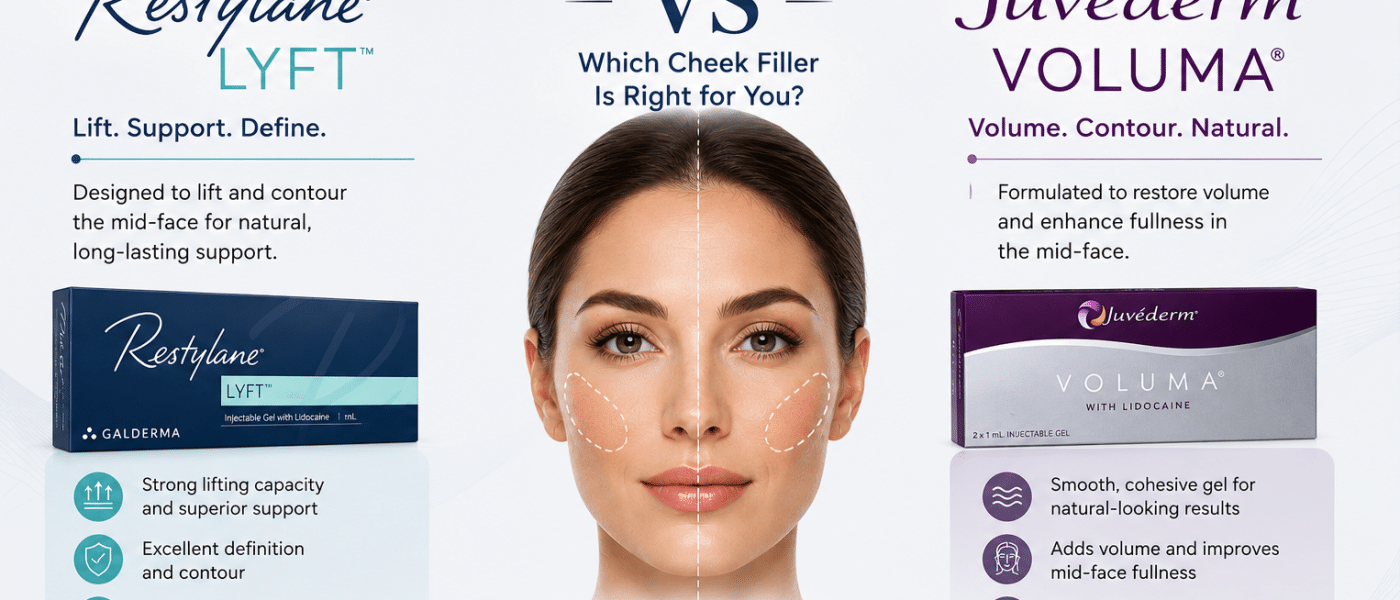
Restylane Lyft is formulated with NASHA® technology, creating a firm gel with excellent lifting capacity and structural support. It is particularly effective for patients who require precise contouring and definition.
Key benefits include:
Strong lifting effect
Excellent facial contouring
Natural structural support
Suitable for moderate to significant volume loss
Because of its higher elasticity (G’), Restylane Lyft is often preferred when sharper definition and support are desired.
Juvederm® Voluma®
Juvederm Voluma is manufactured using Vycross® technology, producing a smooth, cohesive gel that integrates seamlessly into surrounding tissues. It is ideal for restoring soft, natural-looking volume while maintaining facial movement.
Its advantages include:
Smooth tissue integration
Soft, natural appearance
Long-lasting volumization
Excellent projection in the mid-face
Voluma is frequently selected for patients seeking fuller cheeks with subtle, natural enhancement.
Comparing the Two Fillers
Although both products contain cross-linked hyaluronic acid, they differ in their physical properties and clinical performance.
Restylane Lyft generally provides stronger lift and firmer structural support, making it ideal for contouring and facial definition.
Juvederm Voluma offers a softer consistency and excels at restoring volume while maintaining smooth facial transitions.
The choice between the two depends on the patient’s anatomy, degree of volume loss, and desired aesthetic outcome.
Safety and Results
Both fillers have excellent safety profiles when injected by experienced medical professionals. Common temporary side effects include mild swelling, redness, bruising, and tenderness at the injection site, usually resolving within a few days.
Results are visible immediately after treatment and continue to improve as the filler settles naturally into the tissues. Depending on the product used and individual metabolism, results may last up to 18–24 months.
Choosing the Right Filler
There is no single “best” cheek filler. The ideal product depends on facial anatomy, treatment objectives, and practitioner expertise.
Patients seeking stronger lift, definition, and structural support may benefit from Restylane Lyft, while those looking for softer volume enhancement and smooth facial contours may achieve excellent results with Juvederm Voluma.
Conclusion
Restylane Lyft and Juvederm Voluma are both highly effective options for non-surgical facial rejuvenation. When combined with a thorough facial assessment and individualized treatment planning, either filler can restore youthful facial contours, improve harmony, and deliver natural-looking, long-lasting results. Consultation with an experienced aesthetic practitioner is essential to determine which product best suits each patient’s unique facial structure and cosmetic goals.