Biosimilars have become an increasingly important part of modern biologic therapy, providing treatment options that are highly similar to established reference products while potentially improving access and reducing healthcare costs. Unlike conventional generic drugs, biosimilars are complex biological products that must undergo extensive analytical, pharmacokinetic, immunogenicity, and clinical evaluation before approval.
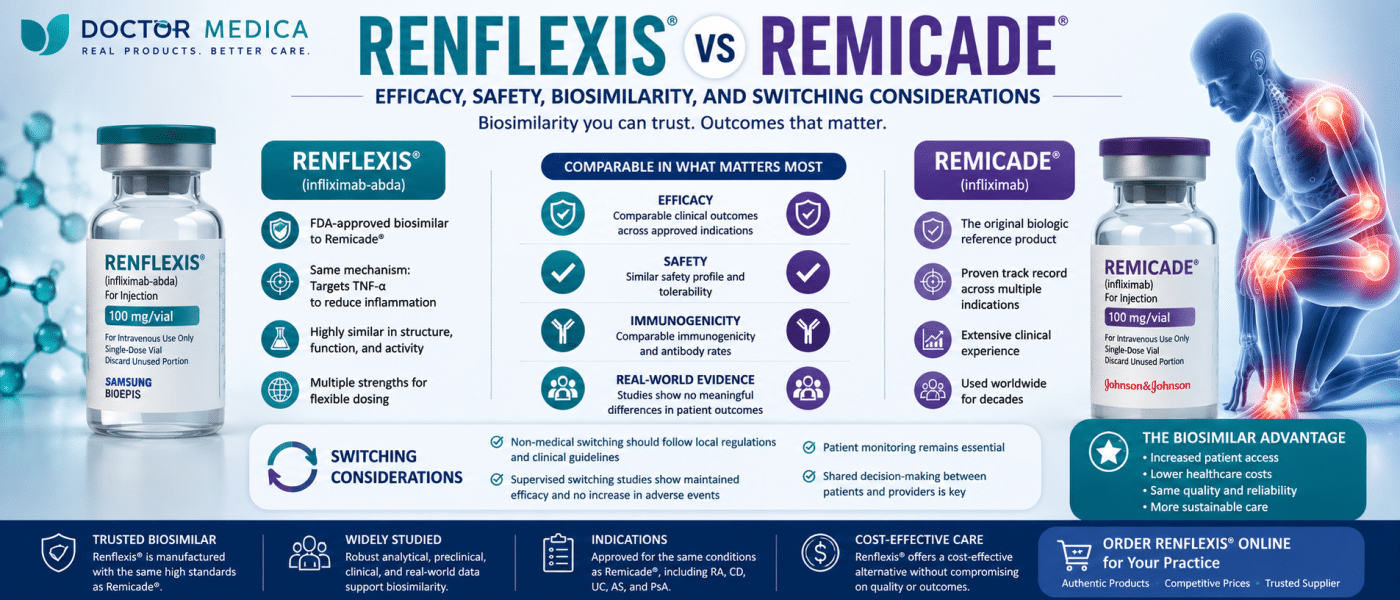
In the field of inflammatory disease treatment, Remicade (infliximab) is one of the best-known reference biologics. Renflexis (infliximab-abda) is an FDA-approved biosimilar designed to provide comparable clinical efficacy and safety to Remicade.
Both products target tumor necrosis factor-alpha (TNF-α), an inflammatory cytokine involved in several chronic immune-mediated diseases. Their clinical use includes conditions such as rheumatoid arthritis, Crohn’s disease, ulcerative colitis, ankylosing spondylitis, psoriatic arthritis, and plaque psoriasis, depending on the approved indication and local regulatory requirements.
Although Renflexis and Remicade share the same therapeutic target, understanding the differences between a biosimilar and its reference product is important for clinicians, healthcare systems, and patients considering a treatment transition.
This article examines Renflexis vs Remicade, focusing on biosimilarity, clinical efficacy, safety, immunogenicity, administration, interchangeability, and practical considerations when switching between treatments.
Key Takeaways
Renflexis (infliximab-abda) is a biosimilar to Remicade (infliximab) and was approved by the FDA in 2017.
Both products inhibit TNF-α, a key mediator of inflammation involved in several autoimmune and inflammatory disorders.
Regulatory approval requires biosimilars to demonstrate that there are no clinically meaningful differences from the reference product in terms of safety, purity, and potency.
Clinical studies have demonstrated comparable treatment outcomes between Renflexis and Remicade for relevant inflammatory conditions.
Both products are administered by intravenous infusion, with dosing determined by the indication and individual treatment plan.
Switching from Remicade to a biosimilar such as Renflexis can be considered in appropriate patients, but decisions should follow applicable regulatory requirements and be supervised by the treating healthcare professional.
Immunogenicity, disease activity, infusion reactions, and treatment response should be monitored as clinically appropriate after a switch.
One potential advantage of biosimilars is improved affordability and access, although actual prices depend on healthcare systems, insurance coverage, contracts, and local market conditions.
Renflexis and Remicade should not be treated as ordinary generic-and-brand equivalents because biologic medicines are structurally more complex than conventional small-molecule drugs.
About: Doctor Medica is a supplier of pharmaceutical and medical products for professional healthcare settings. Product availability, ordering requirements, and regulatory restrictions may vary by country and should be verified before purchase or use.
What Is a Biosimilar?
A biosimilar is a biological product that is highly similar to an already approved reference biologic.
Because biologic medicines are produced using living systems and have complex molecular structures, a biosimilar does not need to be an absolutely identical molecular copy of the reference product in the same way that a conventional generic drug is chemically identical to its reference medicine.
Instead, regulators require manufacturers to demonstrate that any differences are not clinically meaningful.
The evaluation process generally includes:
Analytical characterization
Structural and functional comparison
Pharmacokinetic assessment
Pharmacodynamic evaluation when appropriate
Immunogenicity assessment
Clinical efficacy and safety data
This stepwise approach allows regulators to establish biosimilarity while avoiding unnecessary duplication of every clinical trial originally performed for the reference product.
Renflexis vs Remicade: Product Overview
Remicade is the original infliximab reference product, while Renflexis contains infliximab-abda and is developed as a biosimilar to infliximab.
Both products are monoclonal antibodies that bind to TNF-α and inhibit its biological activity.
Feature Renflexis Remicade
Active biologic Infliximab-abda Infliximab
Product type Biosimilar Reference biologic
Therapeutic target TNF-α TNF-α
Administration Intravenous infusion Intravenous infusion
Mechanism TNF-α inhibition TNF-α inhibition
Development status Biosimilar to Remicade Reference product
Immunogenicity monitoring Relevant Relevant
Storage Refrigerated according to product labeling Refrigerated according to product labeling
Although the products have the same therapeutic target and highly similar biological activity, they can contain differences in manufacturing processes and inactive ingredients.
These differences do not necessarily translate into clinically meaningful differences in treatment outcomes.
How Does Renflexis Work?
Renflexis works by targeting tumor necrosis factor-alpha, or TNF-α.
TNF-α plays an important role in the inflammatory cascade associated with several autoimmune diseases. Excessive TNF-α activity can contribute to inflammation, tissue damage, pain, and progressive disease.
By binding to TNF-α, infliximab can reduce its inflammatory activity.
This mechanism can help control disease manifestations associated with conditions such as:
Rheumatoid arthritis
Crohn’s disease
Ulcerative colitis
Ankylosing spondylitis
Psoriatic arthritis
Plaque psoriasis
The exact approved indications differ by regulatory jurisdiction and product labeling.
Renflexis vs Remicade: Efficacy
One of the most important questions when comparing a biosimilar with its reference product is whether patients can expect comparable clinical outcomes.
The development of Renflexis included comparative studies designed to demonstrate that it provides similar clinical performance to Remicade.
Evidence from clinical trials and switching studies has generally supported comparable efficacy between the two products in appropriate patient populations.
For example, comparative studies in patients with inflammatory diseases have evaluated measures such as:
Clinical response
Disease activity
Remission
Pharmacokinetic exposure
Immunogenicity
Adverse events
The objective of biosimilar development is not to demonstrate that the biosimilar is “better” than the reference product. Instead, the goal is to establish that there are no clinically meaningful differences.
Renflexis and Crohn’s Disease
Infliximab is an established treatment option for certain patients with moderate-to-severe Crohn’s disease.
By inhibiting TNF-α, infliximab can reduce inflammatory activity and help achieve and maintain disease control.
Clinical comparisons involving infliximab biosimilars have demonstrated similar treatment outcomes to the reference product in appropriately selected patients.
When considering a transition from Remicade to Renflexis, clinicians should take into account:
Current disease activity
Previous treatment response
Infusion history
Immunogenicity
Concomitant medications
Patient preference
Insurance or formulary requirements
Treatment decisions should always be individualized.
Renflexis and Rheumatoid Arthritis
Infliximab can also be used in the management of rheumatoid arthritis, generally in combination with methotrexate according to the relevant product labeling.
The therapeutic objective is to reduce inflammatory activity, improve symptoms and physical function, and help prevent disease progression.
Studies evaluating biosimilar infliximab have supported comparable clinical outcomes to reference infliximab in rheumatoid arthritis populations.
As with other biologic therapies, ongoing monitoring remains important because individual response can vary.
Safety Profile: Renflexis vs Remicade
Because Renflexis is a biosimilar to Remicade, its safety profile is expected to be comparable when used according to approved indications.
Potential adverse effects associated with infliximab therapy include:
Infusion-related reactions
Headache
Upper respiratory infections
Nausea
Abdominal discomfort
Injection or infusion-site discomfort
Fatigue
More serious risks associated with TNF inhibitors include:
Serious infections
Reactivation of latent tuberculosis
Hepatitis B reactivation
Severe hypersensitivity reactions
Certain malignancies
Heart failure worsening in susceptible patients
Neurologic or demyelinating disorders in rare cases
Because of these risks, appropriate screening and clinical monitoring are important before and during treatment.
Infusion Reactions and Monitoring
Both Remicade and Renflexis are administered through intravenous infusion.
Healthcare professionals typically monitor patients during and after infusion according to institutional protocols and product labeling.
Symptoms of an infusion reaction may include:
Flushing
Headache
Dizziness
Shortness of breath
Changes in blood pressure
Fever or chills
Chest discomfort
Rash
Severe hypersensitivity reactions require immediate medical assessment and appropriate emergency management.
Patients should report unusual symptoms during or after infusion rather than assuming that they are a normal part of treatment.
Immunogenicity: Why Antibodies Matter
One of the important considerations with biologic therapy is immunogenicity.
Because infliximab is a therapeutic protein, the immune system can sometimes develop anti-drug antibodies.
These antibodies may potentially:
Reduce circulating drug concentrations
Decrease treatment effectiveness
Increase the risk of infusion reactions
Immunogenicity has been evaluated during biosimilar development to ensure that Renflexis behaves comparably to the reference product.
In clinical practice, antibody testing and drug-level monitoring may be considered in selected patients, particularly when there is an unexpected loss of response or concern about treatment failure.
Switching From Remicade to Renflexis
The availability of biosimilars has made treatment switching an important clinical and economic consideration.
A patient who is stable on Remicade may, in some circumstances, be transitioned to Renflexis.
Clinical studies evaluating switching have generally found that many patients can maintain disease control after transitioning from reference infliximab to a biosimilar.
However, switching should not be considered an automatic process.
The healthcare provider should consider:
Disease stability
Previous adverse reactions
Treatment history
Patient concerns
Local prescribing rules
Insurance or formulary policies
The regulatory status of the biosimilar
Patients should also be informed about the reason for the switch and what symptoms or changes in disease activity they should report.
Is Renflexis Interchangeable With Remicade?
Biosimilarity and interchangeability are not necessarily the same regulatory designation.
A product can be FDA-approved as a biosimilar without automatically receiving an interchangeable designation.
An interchangeable biosimilar has met additional regulatory requirements that may allow substitution under applicable pharmacy laws.
Therefore, clinicians and pharmacists should verify the current FDA designation and applicable state or local substitution rules rather than assuming that every biosimilar can be automatically substituted for its reference product.
For healthcare providers, this distinction is particularly important when developing institutional treatment protocols.
Cost and Access Considerations
One of the major reasons biosimilars are increasingly used is their potential to improve access and affordability.
Manufacturing and market competition can allow biosimilars to be offered at lower prices than reference biologics.
However, the actual financial difference between Renflexis and Remicade can vary significantly depending on:
Insurance coverage
Hospital contracts
Pharmacy benefit structures
Government reimbursement
Manufacturer programs
Regional pricing
Infusion-center costs
Therefore, it is more accurate to describe Renflexis as a potentially lower-cost alternative rather than assigning a universal percentage difference.
For healthcare systems, greater biosimilar adoption can contribute to increased competition and potentially reduce overall biologic treatment expenditure.
Storage and Administration
Renflexis and Remicade require appropriate handling throughout the healthcare supply chain.
Both products are generally stored under refrigerated conditions, with specific requirements detailed in their respective prescribing information.
Important considerations include:
Maintaining the appropriate cold chain
Protecting the product according to labeling
Proper preparation for intravenous infusion
Using the product within the manufacturer’s specified timeframe after preparation
Monitoring patients during administration
Healthcare facilities should follow the current official product labeling and institutional protocols rather than relying on generalized storage instructions.
Renflexis vs Other Infliximab Biosimilars
Renflexis is one of several biosimilar options developed around the infliximab reference product.
Other infliximab biosimilars may include products such as Inflectra and additional region-specific products.
Although these medicines share the same reference biologic and therapeutic target, they may differ in:
Manufacturer
Formulation
Excipients
Regulatory status
Interchangeability designation
Availability
Contract pricing
The selection of an infliximab product should therefore consider both clinical and practical factors.
What Should Clinicians Monitor After Switching?
After transitioning from Remicade to Renflexis, clinicians can continue routine disease monitoring while paying particular attention to changes that could suggest loss of response or intolerance.
Depending on the disease, monitoring may include:
Clinical symptoms
Disease activity scores
Laboratory markers of inflammation
Drug concentrations when clinically indicated
Anti-drug antibodies when appropriate
Infusion reactions
Signs of infection
A structured follow-up approach can help distinguish normal fluctuations in disease activity from a clinically significant change in treatment response.
Conclusion
Renflexis and Remicade represent two closely related options within infliximab therapy. Remicade is the reference biologic, while Renflexis is an FDA-approved biosimilar developed to provide comparable clinical performance without clinically meaningful differences in safety or efficacy.
Both target TNF-α and can be used for several chronic inflammatory diseases according to their approved indications.
For patients and healthcare providers, the decision to use or switch to Renflexis may involve several considerations, including clinical response, safety, immunogenicity, regulatory status, insurance coverage, availability, and cost.
The growing availability of biosimilars gives clinicians additional flexibility while potentially improving access to biologic treatment. However, treatment selection and switching decisions should always be made with appropriate healthcare-provider oversight and in accordance with current regulatory guidance and product labeling.