For patients with osteoporosis, reducing fracture risk requires more than simply improving bone density—it requires a treatment strategy that is effective, sustainable, and appropriate for the individual patient. As osteoporosis is a chronic condition, healthcare professionals must consider not only efficacy but also adherence, safety, monitoring, and what happens when treatment eventually needs to change.
One medication frequently considered in patients at high or very high fracture risk is Prolia® (denosumab). As a monoclonal antibody targeting RANKL, denosumab works differently from bisphosphonates and is administered as a 60 mg subcutaneous injection every six months. The Endocrine Society recommends denosumab as an alternative initial treatment for postmenopausal women with osteoporosis who are at high fracture risk.
In this article, we examine what clinical evidence and professional guidance tell us about Prolia, including its effectiveness, tolerability, adherence advantages, monitoring requirements, and discontinuation considerations.
Key Takeaways
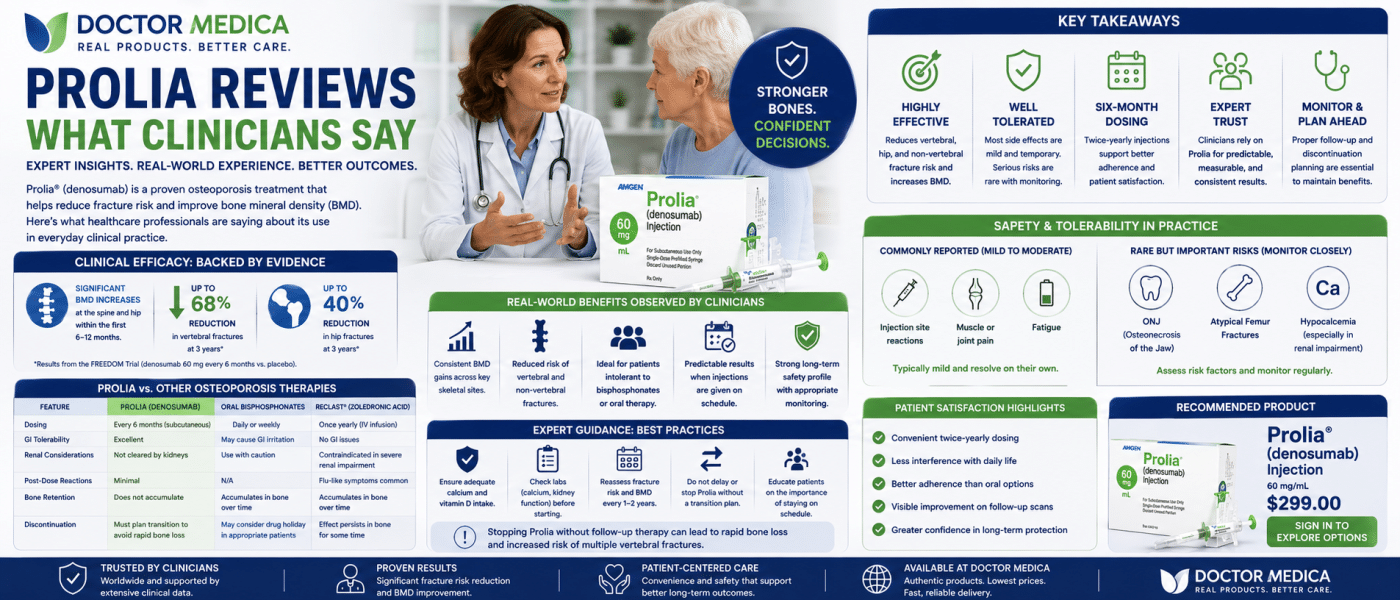
Prolia (denosumab) is an established antiresorptive treatment for osteoporosis and is recommended as an option for selected patients at high fracture risk.
Clinical trials have demonstrated substantial improvements in bone mineral density (BMD) and reductions in vertebral, hip, and nonvertebral fracture risk.
The twice-yearly dosing schedule can simplify treatment compared with daily or weekly oral medications.
Prolia may be particularly useful for patients who cannot tolerate or are not appropriate candidates for oral bisphosphonates.
Clinicians emphasize the importance of calcium and vitamin D adequacy, appropriate monitoring, and assessment of individual risk factors.
Prolia should not be delayed or discontinued without a treatment plan, because bone turnover can rebound after the drug wears off and vertebral fractures may occur after discontinuation.
Long-term studies have demonstrated continued BMD gains with ongoing denosumab therapy, although treatment duration should be individualized.
Clinical Efficacy: What the Evidence Shows
One of the strongest reasons clinicians consider Prolia is its demonstrated ability to increase BMD while reducing fracture risk.
The pivotal FREEDOM trial included 7,808 postmenopausal women with osteoporosis who received either denosumab 60 mg or placebo every six months for three years. Denosumab significantly reduced the risk of new vertebral and hip fractures, while also producing progressive improvements in BMD.
Importantly, BMD improvements were not limited to the spine. Research from FREEDOM demonstrated significant gains at the lumbar spine, total hip, femoral neck, and other skeletal sites during treatment.
For clinicians, this translates into several practical advantages:
Progressive improvement in lumbar-spine BMD
Significant improvement in hip BMD
Reduced risk of vertebral fractures
Reduced risk of hip fractures
Reduction in selected nonvertebral fractures
Continued skeletal benefits when treatment is maintained appropriately
These outcomes help explain why denosumab remains an important option in contemporary osteoporosis management.
Which Patients May Benefit From Prolia?
Treatment decisions should always be individualized, but professional guidelines identify denosumab as an appropriate option for certain patients with elevated fracture risk.
The Endocrine Society recommends denosumab as an alternative initial treatment for postmenopausal women with osteoporosis at high fracture risk. The recommended regimen is 60 mg administered subcutaneously every six months.
The AACE/ACE guideline also identifies denosumab among therapies that may be considered for patients who cannot use oral therapy and for individuals at very high fracture risk.
In clinical practice, potential candidates may include patients who:
Have established osteoporosis with elevated fracture risk
Have difficulty tolerating oral bisphosphonates
Have contraindications or practical difficulties with oral treatment
Prefer an infrequent injectable regimen
Require a potent antiresorptive treatment based on their overall fracture-risk profile
However, Prolia is not automatically the best choice for every patient. Age, fracture history, kidney function, calcium status, previous osteoporosis therapy, comorbidities, and long-term treatment planning all need to be considered.
Safety and Tolerability in Clinical Practice
Safety is a major part of the conversation surrounding Prolia.
The FDA prescribing information identifies several important potential adverse reactions and precautions. These include hypocalcemia, serious infections, osteonecrosis of the jaw, atypical femoral fractures, and multiple vertebral fractures following discontinuation.
Hypocalcemia
Low blood calcium is particularly important to consider before and during treatment.
The FDA recommends correcting pre-existing hypocalcemia before initiating Prolia and ensuring adequate calcium and vitamin D supplementation. Patients with advanced kidney disease or chronic kidney disease–mineral bone disorder require particular attention because their risk of severe hypocalcemia is higher.
Osteonecrosis of the Jaw
Osteonecrosis of the jaw is an uncommon but potentially serious complication. Clinicians should assess relevant dental and medical risk factors and investigate persistent oral symptoms appropriately.
Atypical Femoral Fractures
Although uncommon, atypical femoral fractures have been reported. New or unusual thigh or groin pain should therefore be evaluated rather than ignored.
Infections and Skin Reactions
Serious infections and dermatologic reactions have also been reported. The overall risk must be interpreted within the patient’s individual medical context.
The key message from the prescribing information is that Prolia can be effective and well tolerated, but appropriate patient selection and monitoring remain essential.
Why Patients Often Appreciate the Six-Month Schedule
One practical advantage frequently considered when choosing osteoporosis therapy is dosing convenience.
Rather than taking a tablet every day or week, Prolia is administered once every six months. This can simplify treatment routines and eliminate some of the administration requirements associated with oral bisphosphonates.
For patients who struggle with:
Complex medication schedules
Weekly dosing
Gastrointestinal intolerance
Difficulty remembering regular tablets
Administration requirements associated with oral therapies
a twice-yearly injection may be an attractive option.
However, convenience should never be confused with the ability to stop treatment whenever desired. The six-month dosing interval is pharmacologically important, and professional guidance specifically advises against treatment interruptions without an alternative antiresorptive strategy.
Prolia vs. Bisphosphonates: How Clinicians Compare Them
Prolia and bisphosphonates are both antiresorptive therapies, but they behave differently within the body.
Clinical Consideration Prolia (Denosumab) Bisphosphonates
Mechanism RANKL inhibition Suppression of osteoclast-mediated bone resorption
Administration Subcutaneous injection every 6 months Oral or intravenous, depending on medication
GI considerations Avoids oral gastrointestinal administration Oral agents may cause GI irritation
Bone retention Does not accumulate in bone like bisphosphonates Can remain incorporated in bone for prolonged periods
Treatment interruption Not recommended without follow-on therapy Some patients may qualify for a monitored drug holiday
Monitoring Calcium, vitamin D and individual risk factors Renal function and other factors depending on drug
Major consideration Rebound bone loss/fracture risk after discontinuation Long skeletal retention
The Endocrine Society specifically notes that a drug holiday is not recommended with denosumab, because its effects on bone remodeling reverse after approximately six months if treatment is not administered on schedule.
Long-Term Results With Continued Treatment
Another important question clinicians consider is whether Prolia continues to provide benefits over time.
Long-term data from the FREEDOM extension show that BMD can continue to increase with ongoing denosumab treatment. After five years, women in the long-term treatment group had approximately 13.7% higher lumbar-spine BMD and 7.0% higher total-hip BMD compared with their original baseline.
Further extension data demonstrated continued BMD gains through six years of cumulative treatment, including approximately 15.2% at the lumbar spine and 7.5% at the total hip.
These findings support the concept that denosumab can provide sustained skeletal benefits when administered consistently.
At the same time, clinicians must periodically reassess whether continued therapy remains appropriate. The Endocrine Society recommends reassessing fracture risk after 5–10 years and continuing denosumab or transitioning to another appropriate therapy in patients who remain at high risk.
The Most Important Clinical Consideration: Discontinuation Planning
Perhaps the most important distinction between Prolia and some other osteoporosis treatments is what happens when therapy is stopped.
Denosumab suppresses bone remodeling while active. After the effect wears off, bone turnover can rise rapidly. Consequently, stopping or significantly delaying treatment without follow-on therapy can result in rapid BMD loss and an increased risk of vertebral fractures.
The Endocrine Society therefore recommends that denosumab should not be delayed or stopped without subsequent antiresorptive therapy or another appropriate treatment strategy.
The FDA prescribing information similarly warns about multiple vertebral fractures following Prolia discontinuation and recommends transitioning patients to another antiresorptive agent when Prolia is discontinued.
For healthcare professionals, this means that treatment planning should begin before the final injection, not after a patient has already missed the next dose.
Monitoring Patients Receiving Prolia
A structured follow-up strategy helps maximize the benefits of treatment.
Depending on the individual patient, clinicians may monitor:
Bone Mineral Density
DXA testing provides an objective way to assess changes in bone density. AACE guidance recommends baseline axial DXA and repeat testing at appropriate intervals, commonly every 1–2 years until findings are stable, with subsequent monitoring individualized according to clinical circumstances.
Calcium and Vitamin D
Adequate calcium and vitamin D status is particularly important because of the risk of hypocalcemia. The FDA labeling recommends supplementation and appropriate calcium monitoring in at-risk patients.
Fracture History
Any new fracture while receiving therapy should trigger reassessment of fracture risk, adherence, secondary causes of osteoporosis, and treatment strategy.
Injection Timing
Maintaining the six-month schedule is critical. Delays should be avoided whenever possible and managed according to the patient’s clinical circumstances.
What Do Clinical Reviews Suggest About Patient Satisfaction?
Although patient satisfaction is not the same as clinical efficacy, treatment convenience can influence whether patients remain engaged with long-term osteoporosis care.
A twice-yearly administration schedule may be particularly appealing for patients who find daily or weekly medication difficult to maintain.
At the same time, patient education is essential. Patients should understand that:
Prolia is a long-term osteoporosis treatment
The injection should be administered on schedule
Calcium and vitamin D recommendations should be followed
New thigh, groin, jaw, or severe muscle symptoms should be reported
Treatment should not be stopped independently
A discontinuation strategy should be discussed before treatment ends
Clear communication can help patients understand both the benefits and limitations of therapy.
Conclusion
From a clinical perspective, Prolia (denosumab) remains an important treatment option for appropriately selected patients with osteoporosis, particularly those at high fracture risk or unable to use oral therapies.
Its strong clinical evidence, progressive improvements in BMD, reduction in major osteoporotic fracture risk, and convenient six-month dosing schedule are important advantages.
However, successful Prolia therapy involves more than administering an injection twice a year. Calcium and vitamin D status, renal and metabolic considerations, fracture-risk reassessment, monitoring, and—most importantly—discontinuation planning all form part of responsible long-term management.
For healthcare professionals, the most balanced view is therefore not simply that Prolia is “better” than other osteoporosis treatments. Rather, it is a powerful, evidence-based option whose benefits and risks must be matched to the individual patient.
FAQs
1. Why do doctors prescribe Prolia?
Prolia is used to reduce fracture risk in appropriately selected patients with osteoporosis. It may be particularly useful for patients at high fracture risk or those who cannot use oral osteoporosis medications.
2. How often is Prolia administered?
The recommended osteoporosis dose is 60 mg by subcutaneous injection every six months.
3. Does Prolia increase bone density?
Yes. Clinical trials have demonstrated significant and progressive increases in BMD at the spine, hip, and other skeletal sites during treatment.
4. Can Prolia simply be stopped after several years?
No. Prolia should not be stopped or significantly delayed without an appropriate follow-on treatment plan because discontinuation can lead to rapid bone loss and increased vertebral-fracture risk.
5. What should be monitored during Prolia treatment?
Monitoring is individualized but may include calcium and vitamin D status, renal and metabolic risk factors, fracture history, adverse symptoms, and periodic DXA assessment.