The field of aesthetic medicine is increasingly moving beyond traditional volume replacement toward collagen stimulation and regenerative approaches. Rather than simply adding volume beneath the skin, collagen biostimulators encourage the body to gradually produce its own structural support, resulting in more subtle and progressive changes.
Two well-known poly-L-lactic acid (PLLA) injectables in this category are Lanluma and Sculptra. Both are designed to stimulate collagen production and can help improve the appearance of volume loss, skin laxity, and facial contours. However, their positioning, regulatory status, treatment areas, and clinical use can differ between markets.
In this article, we compare Lanluma vs Sculptra, examining their composition, mechanism of action, treatment areas, expected results, longevity, safety considerations, and practical differences to help clinicians and patients better understand which option may be appropriate for a particular aesthetic goal.
Key Takeaways
Lanluma and Sculptra are PLLA-based collagen biostimulators that work gradually rather than providing the immediate volumization associated with hyaluronic acid fillers.
Both treatments stimulate new collagen formation, helping improve skin firmness, structure, and volume over time.
Sculptra has an established role in facial rejuvenation, while Lanluma is marketed in some regions for both facial and body applications.
Body-contouring applications should always be evaluated according to the product’s local regulatory approval, clinical evidence, and practitioner experience.
Results develop progressively over several weeks or months, and patients generally require a series of treatments rather than a single session.
Individual outcomes depend on factors including age, skin quality, degree of volume loss, treatment area, product selection, and injection technique.
Temporary swelling, redness, tenderness, and bruising can occur after treatment. Delayed nodules or other complications are uncommon but should be discussed during consultation.
Neither product is universally “better.” The appropriate choice depends on the treatment area, patient’s goals, regulatory considerations, and clinician’s experience.
About: Doctor Medica is your trusted supplier of top-quality dermal fillers, viscosupplements, and medical aesthetic products for professional practice. We offer genuine products from leading brands and support clinics in sourcing aesthetic treatments.
Lanluma vs Sculptra: Composition and Mechanism of Action
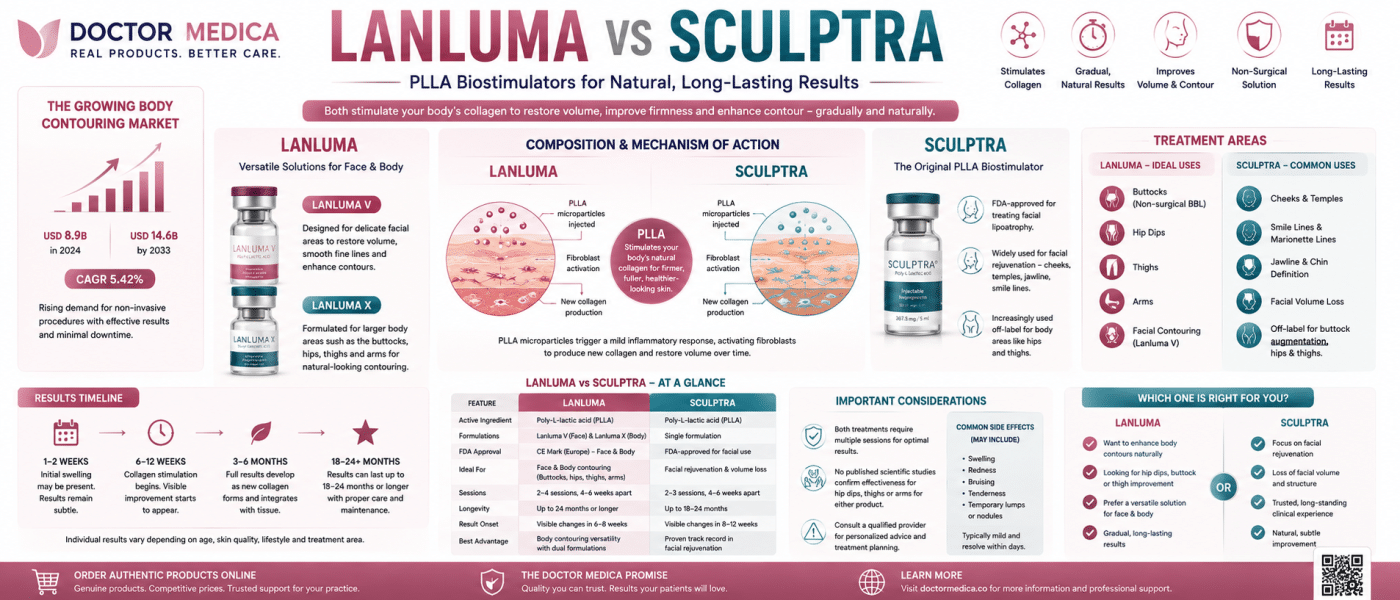
Both Lanluma and Sculptra belong to the PLLA family of injectable collagen stimulators. Instead of functioning primarily as traditional volumizing fillers, they are designed to stimulate the body’s natural regenerative processes.
How PLLA Works
After injection, PLLA microparticles gradually interact with the surrounding tissue and stimulate a controlled biological response. Fibroblasts are activated, encouraging the production of collagen and other extracellular matrix components.
As collagen develops, the treated area can gradually appear:
Fuller
Firmer
Smoother
More supported
More youthful in appearance
This process explains why PLLA treatments do not produce their final aesthetic effect immediately.
Lanluma
Lanluma is a PLLA-based injectable positioned in several markets for facial rejuvenation and body contouring. Depending on the formulation and market, it may be used to address areas where gradual collagen stimulation and volume enhancement are desired.
Its body-focused applications have contributed to interest in non-surgical approaches to areas such as the buttocks, hips, thighs, and other regions affected by laxity or contour irregularities.
Sculptra
Sculptra is also based on poly-L-lactic acid and has a long history of use in aesthetic medicine, particularly for restoring facial volume and improving the appearance of age-related changes.
Its gradual collagen-stimulating mechanism makes it particularly attractive to patients who prefer subtle structural rejuvenation rather than an immediately obvious change.
Importantly, products containing the same general active ingredient should not automatically be considered interchangeable. Their formulations, manufacturing processes, labeling, regulatory approvals, and clinical evidence may differ.
Lanluma vs Sculptra: Facial and Body Treatment Areas
One of the most important distinctions when comparing these treatments is the intended treatment area.
Treatment Goal Lanluma Sculptra
Facial volume restoration ✓ ✓
Skin firmness ✓ ✓
Facial contouring ✓ ✓
Cheeks and temples Depending on market/label ✓
Buttock contouring Market-dependent Often off-label depending on jurisdiction
Hip contouring Market-dependent Often off-label
Thighs and body laxity Market-dependent Evidence and approval vary
Non-surgical body enhancement One of its marketed applications in some markets Primarily known for facial applications
The availability and approved indications for both products can vary considerably by country. Therefore, clinicians should always verify the current local product labeling and regulatory requirements before using either product for a particular indication.
Lanluma for Body Contouring
One of the major reasons Lanluma has attracted attention is its use in body aesthetics.
Rather than acting like a conventional implant or volumizing filler, PLLA is intended to encourage gradual tissue development. This can make it appealing for patients looking for subtle enhancement rather than a dramatic change.
Potential treatment goals may include improving the appearance of:
Buttock contour
Hip irregularities
Mild skin laxity
Thigh texture
Areas with reduced structural support
However, expectations should remain realistic. PLLA injections are not equivalent to surgical fat transfer or implants, and the degree of contour change can vary substantially between patients.
Sculptra for Facial Rejuvenation
Sculptra is particularly associated with facial collagen stimulation.
It may be considered for patients experiencing gradual age-related changes such as:
Loss of cheek fullness
Temple hollowing
Reduced facial support
Fine lines associated with volume loss
Overall loss of youthful facial structure
The goal is generally not to create a visibly “filled” appearance but to produce a progressive and natural-looking improvement.
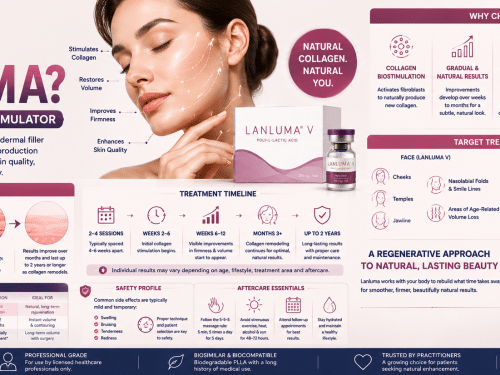
Lanluma vs Sculptra: Treatment Timeline
A major difference between PLLA biostimulators and traditional fillers is the time required for results to develop.
Immediately after treatment, patients may notice temporary fullness caused by the injection process and fluid used during preparation. This initial appearance should not be interpreted as the final result.
Typical Progression
Days 1–7:
Swelling, tenderness, redness, or temporary fullness may occur.
Weeks 2–6:
Initial post-treatment effects gradually settle while collagen stimulation continues.
Weeks 6–12:
Progressive improvements in firmness, volume, and contour may become more noticeable.
Months 3–6:
Collagen remodeling continues and the overall aesthetic result becomes more apparent.
The exact timeline varies according to the patient, treatment area, number of sessions, and individual biological response.
How Many Treatments Are Usually Needed?
PLLA treatments are generally performed as a series rather than a single procedure.
A treatment plan may involve multiple sessions separated by several weeks, allowing the practitioner to assess the patient’s response before determining whether additional treatment is appropriate.
The number of sessions depends on:
Degree of volume loss
Skin laxity
Treatment area
Patient age
Desired level of correction
Previous aesthetic treatments
Individual response to collagen stimulation
A gradual approach is particularly important because adding too much product too quickly can make it difficult to accurately assess the developing result.
Lanluma vs Sculptra: Results and Longevity
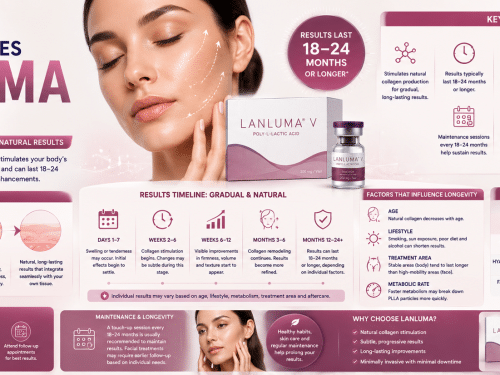
Both products are designed to provide long-lasting collagen-mediated improvements, but longevity should not be presented as a guaranteed fixed period.
The duration of results depends on the patient’s biology, treatment area, number of sessions, lifestyle, and natural aging process.
Patients may experience improvements in:
Skin firmness
Tissue quality
Facial or body contour
Soft-tissue support
Overall skin appearance
Maintenance treatments may eventually be considered to preserve the effect as collagen naturally declines with age.
One of the main advantages of this approach is that the result tends to develop gradually, making it less obvious that an injectable treatment has been performed.
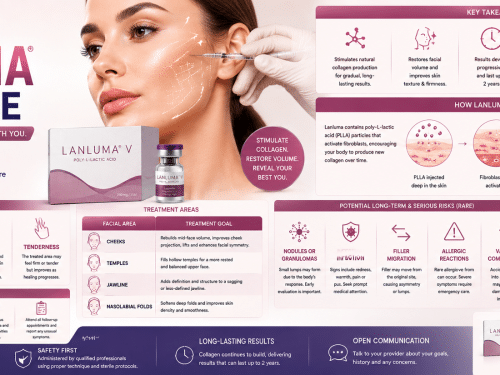
Safety and Potential Side Effects
Like all injectable aesthetic procedures, Lanluma and Sculptra can cause temporary reactions.
Common effects may include:
Redness
Swelling
Tenderness
Bruising
Mild discomfort
Temporary sensitivity
Less common complications can include persistent nodules, inflammatory reactions, infection, or contour irregularities.
Proper patient selection, product preparation, anatomical knowledge, sterile technique, appropriate injection depth, and post-treatment monitoring are essential for minimizing complications.
Patients should also understand that PLLA products require a different treatment philosophy from conventional HA fillers. The gradual nature of collagen stimulation means that overcorrection should be avoided.
Lanluma vs Sculptra: Which One Is Better?
There is no universal winner between Lanluma and Sculptra.
The better option depends on the patient’s specific aesthetic objective and the clinician’s treatment strategy.
Lanluma may be considered when:
Body contouring is an important treatment goal.
The product is approved or appropriately indicated for the intended application in the patient’s market.
The patient wants gradual, natural-looking enhancement.
Skin firmness and contour improvement are desired together.
Sculptra may be considered when:
The primary concern involves facial volume loss.
The patient wants gradual facial rejuvenation.
A long-established PLLA-based treatment is preferred.
The clinician has extensive experience with the product.
The decision should always take into account local regulatory approval, published evidence, product-specific instructions, patient anatomy, and practitioner experience.
Cost and Practical Considerations
Price should not be the only factor when comparing PLLA products.
The total cost of treatment can depend on:
Number of vials required
Number of treatment sessions
Treatment area
Practitioner expertise
Geographic location
Follow-up requirements
Maintenance treatments
Body-contouring procedures may require substantially more product than facial treatments because larger anatomical areas are being addressed.
For professional clinics considering their options, understanding product availability, storage requirements, preparation, training, and regulatory status is just as important as comparing the purchase price.
Patient Selection and Consultation
A successful PLLA treatment begins before the injection.
During consultation, clinicians should evaluate:
Skin quality and elasticity
Existing volume loss
Facial or body proportions
Previous aesthetic procedures
Patient expectations
Medical history and contraindications
Desired degree of enhancement
Patient expectations are particularly important.
Someone looking for an immediate and dramatic increase in volume may be better suited to another treatment approach. In contrast, patients who prefer gradual, subtle changes that develop over time may appreciate collagen biostimulation.
Conclusion
Lanluma vs Sculptra is not simply a comparison of two injectable products. Both represent the broader shift in aesthetic medicine toward collagen stimulation and gradual tissue rejuvenation.
Sculptra has a strong reputation for facial collagen stimulation, while Lanluma has attracted attention for its broader positioning in both facial and body aesthetics in certain markets.
The most appropriate treatment depends on the patient’s anatomy, aesthetic goals, treatment area, product indication, clinical evidence, and practitioner expertise.
When used appropriately, PLLA biostimulators can provide a subtle alternative to immediate volumization, helping patients achieve progressive improvements in firmness, structure, and contour while maintaining a natural-looking appearance.