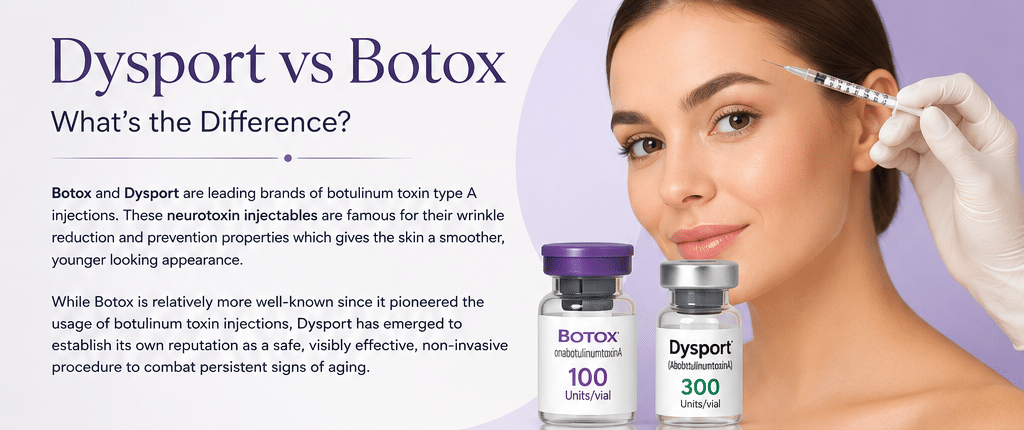
Botox and Dysport are two of the most popular botulinum toxin type A treatments used in aesthetic medicine today. Both are non-surgical injectable treatments designed to reduce the appearance of dynamic wrinkles by temporarily relaxing the facial muscles responsible for repetitive expressions.
Although Botox has been the best-known name in cosmetic injectables for many years, Dysport has become an increasingly popular alternative thanks to its fast-acting results, natural-looking outcomes, and competitive pricing.
Dysport vs Botox: Understanding the Difference
Both Dysport and Botox contain botulinum toxin type A, a purified protein that temporarily blocks nerve signals to targeted muscles. By limiting muscle contractions, these treatments help soften existing wrinkles while preventing new expression lines from becoming deeper over time.
They are commonly used to treat:
Frown lines between the eyebrows (glabellar lines)
Horizontal forehead lines
Crow’s feet around the eyes
While both products achieve similar cosmetic results, they differ slightly in their formulation, diffusion characteristics, and dosing.
One of the biggest differences is how quickly the results become noticeable. Dysport typically begins working within 2–3 days, while Botox usually requires 3–7 days before visible improvements appear. Full results for both treatments are generally seen after about two weeks.
Because Dysport spreads more easily after injection, it may be particularly suitable for treating larger areas such as the forehead. Botox, on the other hand, offers more localized precision, making it an excellent option for smaller treatment areas.
What Is Dysport?
Dysport is an FDA-approved injectable treatment used to temporarily improve moderate to severe facial wrinkles caused by repeated muscle movements. It has been safely used worldwide for both cosmetic and medical purposes for many years.
The treatment works by relaxing specific facial muscles responsible for expression lines. As these muscles become less active, the overlying skin appears smoother, resulting in a more refreshed and youthful appearance without affecting your natural facial expressions when administered correctly.
Many patients choose Dysport because of its quick onset and soft, natural-looking results. It is especially popular among individuals seeking subtle facial rejuvenation with little to no downtime.
How Much Does Dysport Cost?
The price of Dysport varies depending on the treatment area, the number of units required, and the experience of the injector.
Although Dysport generally requires more units than Botox due to differences in potency measurements, the cost per unit is usually lower. As a result, the total treatment price is often similar to—or in some cases less than—a comparable Botox procedure.
It is important to remember that treatment cost should not be the only deciding factor. The injector’s expertise, proper dosing, and individualized treatment plan have a much greater impact on achieving safe and natural-looking results.
How Long Does Dysport Last?
Most patients enjoy the effects of Dysport for approximately three to four months. Individual results can vary depending on factors such as metabolism, muscle strength, lifestyle, and the treated area.
With regular maintenance treatments, many patients find that their results become more consistent over time, helping to keep facial lines softer and less noticeable.
Is Dysport Better Than Botox?
Neither Dysport nor Botox is universally better—they are both highly effective products with excellent safety records. The ideal choice depends on your facial anatomy, treatment goals, and the recommendations of a qualified medical professional.
Patients looking for faster visible results may prefer Dysport, while others may benefit from Botox’s more concentrated spread in specific facial areas. During a consultation, an experienced injector can determine which product is best suited to your individual needs.
Conclusion
Dysport has established itself as one of the leading injectable treatments for reducing expression lines and maintaining a youthful appearance. Its fast onset, reliable performance, and natural-looking results make it an excellent choice for patients seeking a minimally invasive facial rejuvenation treatment.
Whether you choose Dysport or Botox, the quality of your results depends largely on the skill and experience of your practitioner. Consulting a qualified aesthetic professional ensures that your treatment is tailored to your facial structure and cosmetic goals while maintaining a balanced, natural expression.