Regenerative Aesthetic Medicine: The Science of Biostimulatory Injectables and the Future of Natural Facial Rejuvenation
As aesthetic medicine continues to evolve, the focus has shifted from simply replacing lost volume to restoring the skin’s natural regenerative capacity. Rather than creating immediate correction through traditional dermal fillers, modern regenerative treatments stimulate the body’s own collagen production, providing gradual, long-lasting, and naturally integrated results.
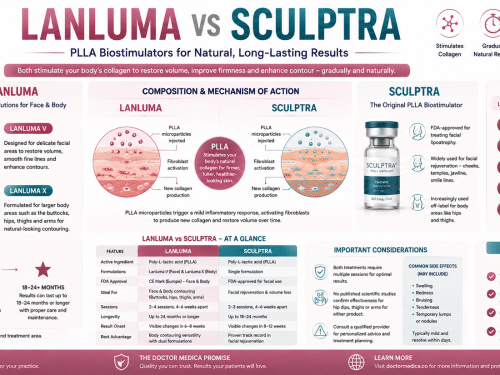
Collagen biostimulators such as Poly-L-Lactic Acid (PLLA) and Calcium Hydroxylapatite (CaHA) have become essential tools for practitioners seeking structural facial rejuvenation instead of temporary camouflage. These products work by activating fibroblasts and promoting neocollagenesis, improving skin quality, elasticity, and facial support over time.
Unlike hyaluronic acid fillers, which primarily restore volume through hydration and gel placement, collagen stimulators initiate biological remodeling that continues for months after treatment. As a result, successful outcomes rely not only on injection technique but also on patient selection, treatment planning, and effective expectation management.
Understanding Collagen Biostimulators
Biostimulatory injectables function differently from conventional fillers. Their primary purpose is not to occupy space but to encourage the body’s natural healing mechanisms to rebuild collagen and extracellular matrix components.
Poly-L-Lactic Acid (PLLA)
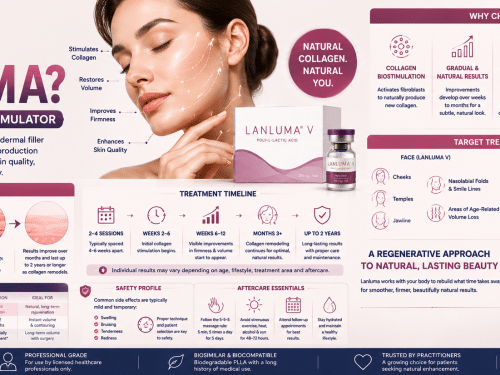
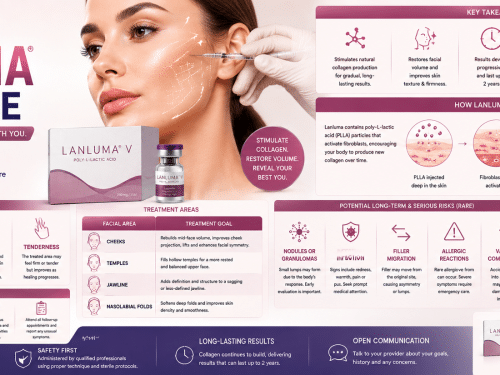
PLLA is a biodegradable synthetic polymer widely used for progressive facial rejuvenation. After injection into the deep dermis or supraperiosteal layer, PLLA particles trigger a mild inflammatory response that activates fibroblasts.
Over the following months, these fibroblasts synthesize new Type I collagen while the PLLA particles gradually degrade into carbon dioxide and water. The newly formed collagen network restores facial support, softens age-related volume loss, and improves skin texture in a subtle, natural manner.
Because collagen synthesis is progressive, multiple treatment sessions are typically required to achieve optimal correction.
Calcium Hydroxylapatite (CaHA)
CaHA combines immediate structural support with long-term tissue regeneration. The microspheres are suspended within a gel carrier that provides instant lifting, while the calcium hydroxylapatite particles stimulate collagen and elastin production as the carrier gel is resorbed.
One of CaHA’s greatest advantages is its versatility. Undiluted formulations provide excellent structural definition for areas such as the jawline and chin, whereas diluted or hyperdiluted protocols improve skin firmness and laxity without adding significant volume.
Why Comprehensive Patient Assessment Is Essential
Biostimulation depends on the patient’s biological ability to generate new collagen. Therefore, careful consultation is considerably more important than with conventional fillers.
Evaluating Biological Potential
Collagen production naturally declines with aging due to reduced fibroblast activity, hormonal changes, oxidative stress, and cumulative ultraviolet damage.
Patients with healthier skin quality, balanced nutrition, and minimal photodamage generally demonstrate stronger regenerative responses.
Conversely, individuals with severe dermal atrophy or advanced photoaging may require more treatment sessions and larger product volumes before visible improvements develop.
Understanding Patient Expectations
One of the defining characteristics of collagen stimulators is delayed gratification.
Patients expecting immediate transformation before weddings, vacations, or special events may be disappointed because the regenerative process requires time.
Ideal candidates understand that the objective is long-term tissue remodeling rather than instant cosmetic enhancement. Proper counseling during consultation significantly improves treatment satisfaction and reduces unnecessary follow-up concerns.
Comprehensive Facial Assessment Before Treatment
Every treatment plan should begin with a complete facial analysis rather than focusing solely on individual wrinkles.
Skin Quality
The clinician should evaluate:
Dermal thickness
Skin elasticity
Hydration
Degree of photodamage
Presence of atrophic skin
Patients with extremely thin skin often benefit from diluted treatment protocols that encourage diffuse collagen formation while minimizing the risk of palpable irregularities.
Facial Volume Distribution
Different patterns of aging require different treatment strategies.
Diffuse Volume Loss
Patients with generalized facial hollowing, temple deflation, and midface volume loss often respond exceptionally well to PLLA because it produces gradual global restoration.
Structural Deficiencies
Patients seeking stronger jawline definition, chin projection, or cheek contour typically benefit more from CaHA due to its superior lifting capacity and structural support.
Choosing the Appropriate Injection Plane
Treatment depth directly influences both safety and clinical outcomes.
PLLA is commonly placed in deeper tissue planes to promote even collagen deposition while minimizing superficial nodules.
CaHA may be injected deeply for skeletal support or more superficially in diluted protocols designed to improve skin quality and firmness.
Educating Patients About the Treatment Timeline
Expectation management is one of the strongest predictors of patient satisfaction.
Practitioners should clearly explain the biological timeline before treatment begins.
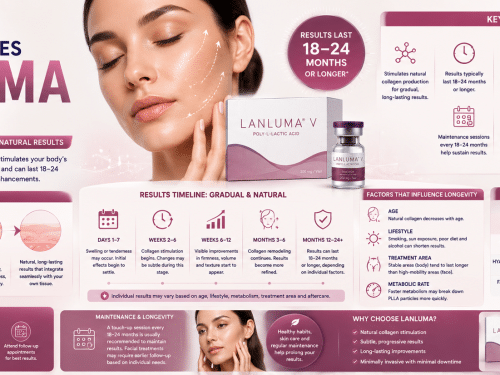
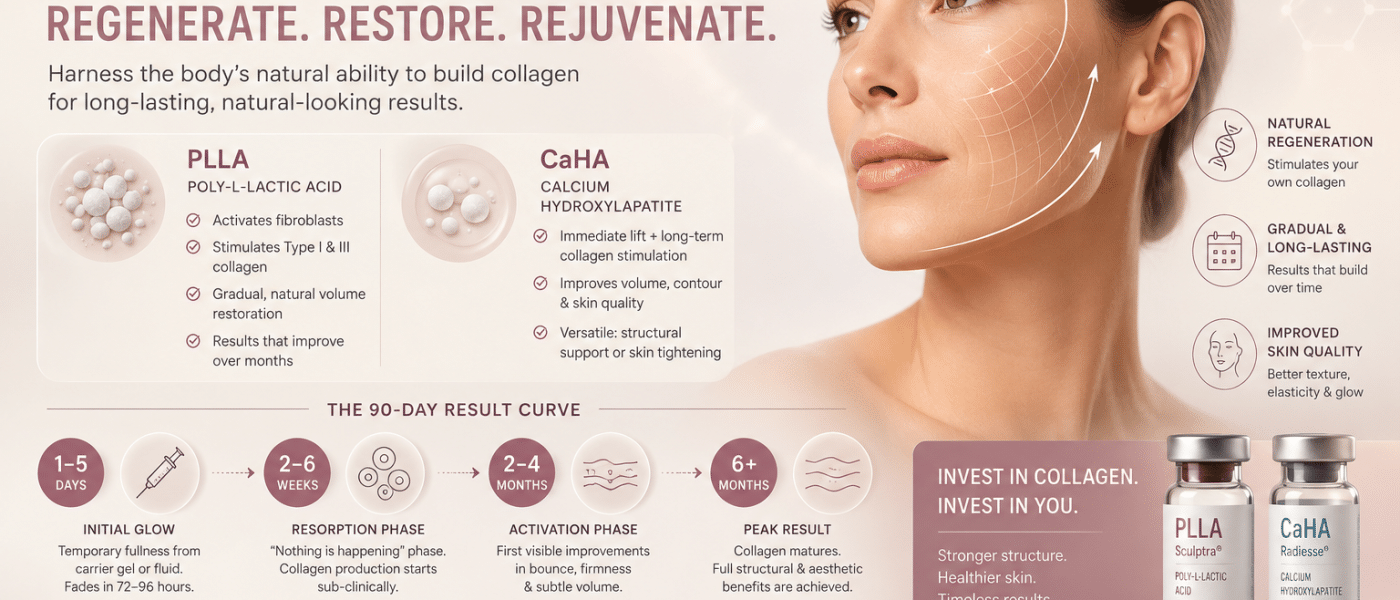
Days 1–5
Patients often notice immediate fullness caused by the carrier gel or injection fluid rather than newly formed collagen.
This temporary effect gradually subsides within several days.
Weeks 2–6
Many patients experience a period during which visible improvement appears minimal.
Although collagen synthesis has already begun microscopically, clinical changes remain subtle.
Without appropriate counseling, this stage often generates unnecessary anxiety.
Months 2–4
Fibroblast activity becomes increasingly evident.
Patients typically observe:
Improved skin firmness
Enhanced elasticity
Better facial support
More youthful skin texture
Progressive soft tissue restoration
After Six Months
The collagen matrix reaches greater maturity, producing the most natural and stable aesthetic outcome.
Rather than appearing “filled,” patients simply look healthier, fresher, and less fatigued.
Long-Term Treatment Planning
Collagen stimulation should be viewed as an ongoing regenerative strategy rather than a single cosmetic procedure.
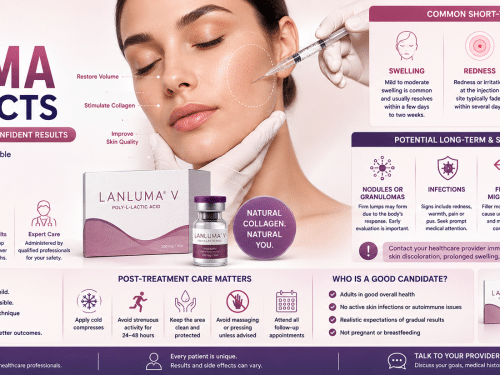
Most patients benefit from two or three initial treatment sessions performed approximately four to eight weeks apart.
Once optimal collagen remodeling has occurred, maintenance treatments every 12 to 18 months help preserve structural support and slow the visible effects of facial aging.
Because the regenerated tissue belongs to the patient rather than the injectable product, clinical improvements often remain visible considerably longer than conventional filler treatments.
Follow-Up and Outcome Evaluation
Structured follow-up appointments are an integral component of regenerative aesthetic medicine.
Clinical photography performed before treatment and repeated three to six months later provides objective documentation of collagen remodeling.
Many patients underestimate their gradual improvement because daily changes occur slowly. Side-by-side photographic comparison often demonstrates substantial enhancement in facial volume, skin quality, and overall facial harmony that may otherwise go unnoticed.
Conclusion
Collagen biostimulators have transformed aesthetic medicine by shifting the emphasis from temporary correction to biological regeneration.
Rather than replacing lost volume alone, these treatments activate the body’s own regenerative mechanisms to rebuild collagen, strengthen facial architecture, and improve skin quality over time.
Successful outcomes depend on far more than precise injection technique. Careful patient selection, individualized treatment planning, realistic expectation management, and consistent follow-up are equally important in achieving predictable, long-lasting results.
As regenerative aesthetics continues to advance, collagen biostimulation represents one of the most scientifically grounded approaches to facial rejuvenation—delivering subtle, natural-looking improvements that age gracefully with the patient while preserving authentic facial expression and structural integrity.