Biosimilars have become an increasingly important part of modern biologic therapy, offering highly similar alternatives to established reference products while potentially improving access and reducing treatment costs. One of the best-known examples in inflammatory disease is Renflexis (infliximab-abda), a biosimilar to Remicade (infliximab).
Both products target tumor necrosis factor-alpha (TNF-α), a key inflammatory mediator involved in conditions such as Crohn’s disease, ulcerative colitis, rheumatoid arthritis, ankylosing spondylitis, psoriatic arthritis, and plaque psoriasis. Renflexis received FDA approval in 2017, with the FDA determining that it is highly similar to Remicade and has no clinically meaningful differences in safety or effectiveness for its approved uses.
Despite these similarities, clinicians and patients may still have questions about clinical efficacy, immunogenicity, safety, treatment protocols, cost, and switching from Remicade to Renflexis.
In this article, we’ll examine Renflexis vs Remicade, explaining how biosimilarity is established, what clinical evidence shows, and what patients and healthcare professionals should consider when changing from the originator biologic to its biosimilar.
Key Takeaways
Renflexis (infliximab-abda) is an FDA-approved biosimilar to Remicade (infliximab).
Both medicines are TNF blockers used for several chronic inflammatory and autoimmune conditions.
FDA biosimilar approval requires evidence demonstrating high similarity and no clinically meaningful differences in safety, purity, or potency compared with the reference product.
Renflexis and Remicade use the same fundamental mechanism of action: blocking TNF-α to reduce inflammatory activity.
Clinical studies of the SB2 biosimilar development program demonstrated comparable efficacy, pharmacokinetics, safety, and immunogenicity to reference infliximab.
Evidence from switching studies with infliximab biosimilars supports maintaining disease control after a supervised switch from the originator.
Renflexis is administered by intravenous infusion, with dosing schedules depending on the indication.
Both products carry important risks associated with infliximab therapy, including serious infections, infusion reactions, and malignancies, so appropriate screening and monitoring are essential.
Renflexis is a biosimilar, but biosimilar status should not automatically be confused with pharmacy-level interchangeability. Substitution rules depend on FDA interchangeability status and applicable state law.
The choice between Renflexis and Remicade may depend on formulary policies, insurance coverage, treatment history, clinician preference, and patient-specific considerations.
What Makes Renflexis a Biosimilar to Remicade?
A biosimilar is not simply a generic version of a biologic. Because biologic medicines are produced using living systems, they cannot be copied molecule-for-molecule in the same way as conventional small-molecule drugs.
Instead, regulatory agencies require biosimilars to demonstrate that they are highly similar to the reference biologic and that any differences are not clinically meaningful. The FDA explains that approved biosimilars must have no clinically meaningful differences from their reference products in terms of safety and effectiveness.
Renflexis contains infliximab-abda and is referenced against Remicade (infliximab). The FDA Purple Book identifies Renflexis as a 351(k) biosimilar to Remicade, with an original approval date of April 21, 2017.
Key Areas of Biosimilarity
Analytical comparability:
Renflexis underwent extensive analytical characterization to compare its structural and functional properties with reference infliximab. Research on the SB2 development program found high similarity between the biosimilar and Remicade across critical quality attributes.
Pharmacokinetics:
Comparative studies evaluate whether the two products behave similarly in the body, including their exposure and elimination.
Pharmacodynamics and biological activity:
Functional testing examines whether the biosimilar produces the same relevant biological effects as the reference product.
Immunogenicity:
Because biologics can trigger anti-drug antibodies, clinical development also evaluates whether the biosimilar has a comparable immune-response profile.
Together, these layers of evidence create a totality-of-evidence approach, rather than relying on a single clinical trial.
Renflexis vs Remicade: Mechanism of Action
Both Renflexis and Remicade contain infliximab, an antibody that targets TNF-α.
TNF-α is an inflammatory cytokine involved in the development and persistence of inflammation in several immune-mediated diseases. By binding TNF-α, infliximab reduces downstream inflammatory signaling.
This mechanism is relevant across multiple approved indications, including:
Crohn’s disease
Ulcerative colitis
Rheumatoid arthritis
Ankylosing spondylitis
Psoriatic arthritis
Plaque psoriasis
The current U.S. Renflexis prescribing information lists these indications, including pediatric Crohn’s disease and ulcerative colitis for patients aged 6 years and older.
Because Renflexis and Remicade share the same fundamental mechanism, the comparison is primarily about biosimilarity, clinical performance, safety, and practical considerations, rather than fundamentally different pharmacological approaches.
Clinical Evidence: Efficacy and Safety
One of the most important questions surrounding any biosimilar is whether patients can expect the same therapeutic benefit as they would from the reference biologic.
The clinical development program for SB2, the infliximab biosimilar marketed as Renflexis in the U.S., included comparative studies in rheumatoid arthritis.
In a randomized phase III study involving patients with moderate-to-severe rheumatoid arthritis receiving methotrexate, the ACR20 response at week 30 was 64.1% with SB2 compared with 66.0% with reference infliximab. The difference fell within the predefined equivalence margin. Safety, pharmacokinetics, and anti-drug antibody results were also comparable.
A subsequent transition study evaluated patients who switched from reference infliximab to SB2. Efficacy remained comparable across groups, with no meaningful differences in safety or immunogenicity identified during the transition period.
These findings support the regulatory conclusion that Renflexis can provide a therapeutic profile comparable to Remicade when used according to its approved indications.
Renflexis vs Remicade: Indications and Treatment Schedule
Renflexis and Remicade have closely aligned approved uses, and treatment schedules are indication-specific.
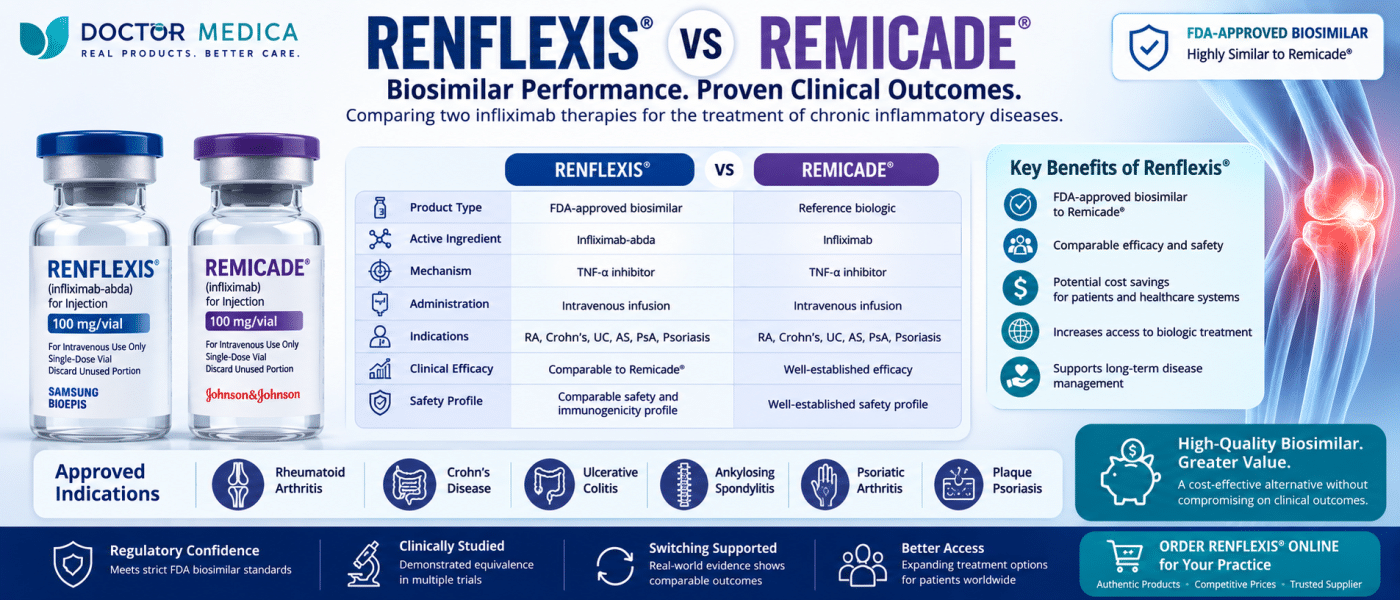
Feature Remicade Renflexis
Active ingredient Infliximab Infliximab-abda
Product type Reference biologic Biosimilar
Mechanism TNF-α inhibition TNF-α inhibition
Administration IV infusion IV infusion
Crohn’s disease Yes Yes
Ulcerative colitis Yes Yes
Rheumatoid arthritis Yes Yes
Ankylosing spondylitis Yes Yes
Psoriatic arthritis Yes Yes
Plaque psoriasis Yes Yes
Typical induction 0, 2 and 6 weeks 0, 2 and 6 weeks
Maintenance Depends on indication Depends on indication
FDA biosimilar status Reference product FDA-approved biosimilar
For example, the current U.S. Renflexis label recommends 5 mg/kg at weeks 0, 2, and 6 followed by every-8-week dosing for adult Crohn’s disease and ulcerative colitis. Rheumatoid arthritis uses 3 mg/kg at weeks 0, 2, and 6 followed by every 8 weeks, in combination with methotrexate. Other indications have different maintenance schedules.
Treatment should therefore always follow the prescribing information and the individualized plan established by the treating specialist.
Switching from Remicade to Renflexis
Switching from a reference biologic to a biosimilar can sometimes cause concern, particularly for patients who have been stable on treatment for several years.
However, evidence from the broader infliximab biosimilar literature has generally been reassuring.
The NOR-SWITCH trial demonstrated that switching patients from originator infliximab to the biosimilar CT-P13 was not inferior to continued originator treatment. The long-term extension also found comparable efficacy, safety, and immunogenicity between patients who continued the biosimilar and those who switched to it after receiving originator infliximab.
A systematic review published more recently, incorporating 85 publications, likewise found that clinical effectiveness and safety outcomes after switching from originator infliximab to a biosimilar were generally consistent with the established infliximab profile.
Importantly, much of this switching evidence concerns infliximab biosimilars as a class, and not every study specifically evaluates Renflexis. Therefore, results should be interpreted within the context of the individual product and regulatory evidence.
What Should Be Monitored After a Switch?
Healthcare professionals may monitor:
Disease activity and symptom control
Infusion reactions
Anti-drug antibodies when clinically indicated
Drug levels when therapeutic drug monitoring is appropriate
Adherence to the infusion schedule
Signs of infection or other adverse effects
Patient education is also important. A planned and well-explained transition can help address concerns about changing from a familiar originator biologic.
Safety Profile and Important Precautions
Because Renflexis and Remicade are both infliximab products, they share important safety considerations.
The current Renflexis prescribing information contains a boxed warning for serious infections and malignancy. Patients receiving infliximab products may have an increased risk of serious infections, including tuberculosis and invasive fungal infections. Screening for latent tuberculosis before treatment and monitoring during therapy are recommended.
Other important precautions include:
Serious infections
Infusion-related and hypersensitivity reactions
Hepatitis B reactivation
Malignancies
Heart failure
Hematologic abnormalities
Demyelinating disease
Liver injury
Lupus-like syndrome
Common adverse reactions reported with Renflexis include infections, infusion-related reactions, headache, and abdominal pain.
These risks mean that Renflexis should be administered under appropriate medical supervision, with patient screening and monitoring based on the individual’s medical history.
Cost and Access: Why Biosimilars Matter
One of the strongest arguments for biosimilars is their potential to increase access to biologic treatment.
Because biosimilars can be manufactured and marketed after the reference product’s exclusivity and patent protections allow entry, they may create additional competition in the biologics market.
For healthcare systems, this can potentially:
Reduce treatment expenditure
Expand access to biologic therapies
Increase treatment options
Improve formulary flexibility
Allow healthcare resources to be redirected toward other areas of patient care
However, the actual price difference between Renflexis and Remicade varies considerably by country, insurer, hospital, purchasing agreement, and reimbursement system. Therefore, it is more accurate to view biosimilar adoption as a potential cost-saving strategy rather than assuming a fixed percentage reduction.
Renflexis vs Remicade: Key Differences at a Glance
Factor Remicade Renflexis
Product category Originator biologic Biosimilar
Active molecule Infliximab Infliximab-abda
Reference relationship Reference product Biosimilar to Remicade
Mechanism TNF-α blockade TNF-α blockade
Administration IV IV
Clinical efficacy Established Comparable to reference
Safety profile Established infliximab profile Comparable based on biosimilar evidence
Immunogenicity Known risk Comparable profile expected
FDA status Reference biologic FDA-approved biosimilar
Switching N/A Should be managed according to clinical and regulatory requirements
Cost Often higher May offer economic advantages
Conclusion
The comparison of Renflexis vs Remicade demonstrates how modern biosimilars can provide an additional treatment option without requiring a fundamentally different therapeutic approach.
Renflexis (infliximab-abda) is highly similar to Remicade (infliximab), with comparative evidence supporting similar efficacy, pharmacokinetics, safety, and immunogenicity. FDA approval is based on a comprehensive evaluation rather than simply demonstrating that the products contain the same active ingredient.
For patients who are stable on Remicade, available evidence from infliximab biosimilar switching studies is generally reassuring, although switching decisions should be made with the treating healthcare professional and should take into account disease activity, previous treatment response, insurance or formulary requirements, and patient preference.
Ultimately, the choice between Renflexis and Remicade is less about one product being universally “better” and more about clinical suitability, access, treatment history, monitoring, and healthcare-system considerations.
Medical treatment decisions should always be made with a qualified healthcare professional. The information above is for educational purposes and does not replace prescribing information or individualized medical advice.