Sodium hyaluronate, the active ingredient in Euflexxa, is a naturally occurring substance that plays an important role in maintaining the lubrication and shock-absorbing properties of healthy joints. In people with knee osteoarthritis (OA), the quality and concentration of hyaluronic acid in the synovial fluid can decline, contributing to stiffness, friction, and discomfort during movement.
To address these changes, viscosupplementation uses injectable hyaluronic acid products to supplement the joint’s natural synovial fluid. One such product is Euflexxa, a non-avian, high-molecular-weight sodium hyaluronate viscosupplement specifically indicated for the treatment of pain associated with knee osteoarthritis.
Unlike some hyaluronic acid products that have historically been derived from animal sources, Euflexxa is manufactured through bacterial fermentation, providing a non-avian formulation.
In this article, we’ll explore the Euflexxa generic name, its composition and mechanism of action, administration schedule, regulatory status, and how it compares with other hyaluronic acid injections used in knee osteoarthritis management.
Key Takeaways
The generic name of Euflexxa is sodium hyaluronate, a form of hyaluronic acid naturally found in synovial fluid.
Euflexxa is a hyaluronic acid viscosupplement designed to supplement the lubricating and cushioning properties of joint fluid.
Euflexxa is manufactured using bacterial fermentation, making it a non-avian product without rooster-comb-derived proteins.
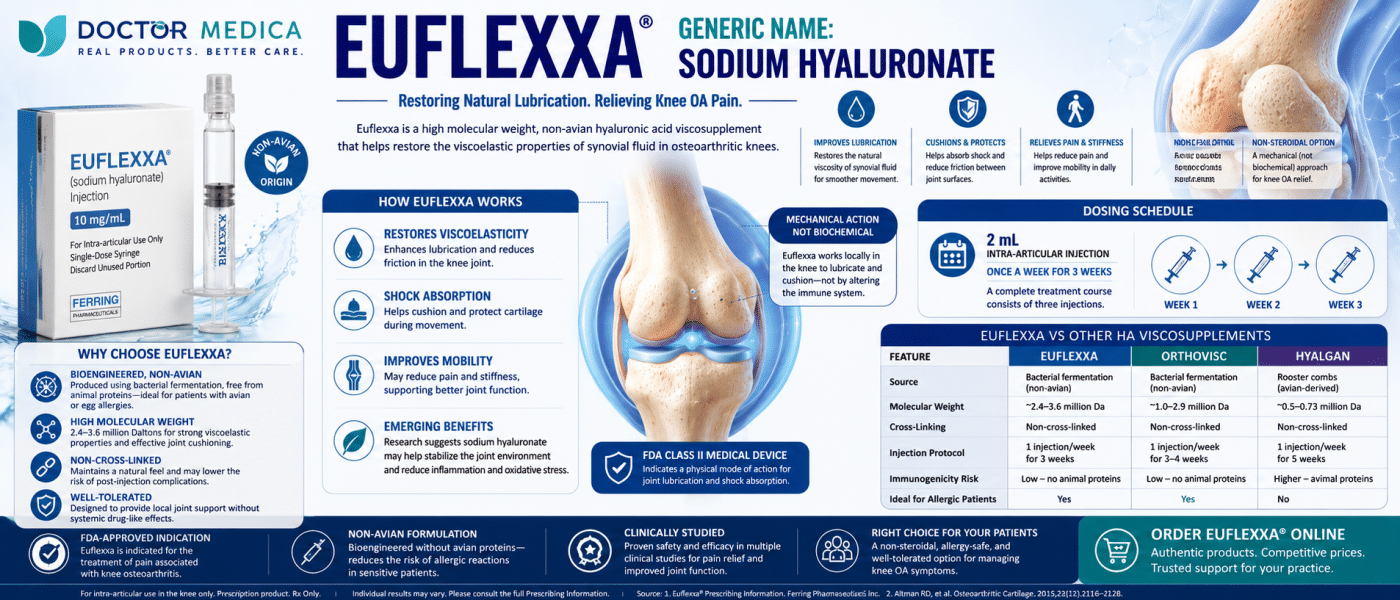
Its molecular weight is approximately 2.4–3.6 million Daltons, contributing to its viscoelastic properties.
Euflexxa is non-cross-linked, distinguishing it from some chemically modified HA formulations.
The treatment is administered as 2 mL intra-articular injections once weekly for three consecutive weeks.
Its primary effect is local and mechanical, helping improve lubrication and shock absorption within the knee joint.
Clinical response can vary considerably depending on osteoarthritis severity, patient characteristics, and previous treatment history.
Common post-injection reactions may include temporary pain, swelling, stiffness, or tenderness around the treated joint.
Because Euflexxa is non-avian, it may be an option for patients with concerns about avian-derived ingredients, although individual contraindications and allergies must always be assessed by a healthcare professional.
The choice between Euflexxa and other viscosupplements should consider formulation, injection schedule, clinical history, availability, and insurance coverage.
About: Doctor Medica is your trusted supplier of authentic dermal fillers, viscosupplements, and medical and aesthetic products for professional use. Healthcare providers should source products through reputable suppliers and verify product authenticity before administration.
Recommended Product
EUFLEXXA® 10 mg/mL
Euflexxa is supplied as a prefilled syringe containing 2 mL of sodium hyaluronate solution for intra-articular administration.
What Is the Euflexxa Generic Name? Understanding Sodium Hyaluronate
The Euflexxa generic name is sodium hyaluronate. Sodium hyaluronate is the sodium salt of hyaluronic acid, a polysaccharide naturally present throughout the body, including the skin, connective tissues, and synovial fluid surrounding joints.
In a healthy knee, hyaluronic acid contributes to the viscoelastic properties of synovial fluid. It helps the joint surfaces move smoothly against one another while also assisting with shock absorption during activities such as walking, climbing stairs, and exercising.
In osteoarthritis, changes in the concentration, molecular weight, and functional quality of endogenous hyaluronic acid can affect the protective properties of synovial fluid.
Euflexxa is designed to supplement these properties by introducing sodium hyaluronate directly into the affected knee.
Euflexxa Formulation
Several characteristics distinguish Euflexxa from other viscosupplementation products:
Active ingredient: Sodium hyaluronate
Concentration: 10 mg/mL
Injection volume: 2 mL
Origin: Non-avian, produced through bacterial fermentation
Molecular weight: Approximately 2.4–3.6 million Daltons
Cross-linking: Non-cross-linked
Administration: Intra-articular injection into the knee
The formulation is intended to provide a viscoelastic material that can function within the joint environment and supplement the properties of natural synovial fluid.
How Does Euflexxa Work in Knee Osteoarthritis?
The primary action of sodium hyaluronate is local rather than systemic. After intra-articular administration, the material contributes to the lubrication and cushioning characteristics of the synovial environment.
1. Joint Lubrication
Hyaluronic acid helps reduce friction between articulating joint surfaces. By supplementing the viscous properties of synovial fluid, Euflexxa may help support smoother movement.
2. Shock Absorption
Healthy synovial fluid contributes to the knee’s ability to distribute mechanical forces. Sodium hyaluronate provides viscoelastic cushioning, helping the joint manage mechanical loads during movement.
3. Improved Joint Function
By improving the physical characteristics of the joint environment, viscosupplementation may help some patients experience improvements in pain, stiffness, and mobility.
4. Potential Biological Effects
Although viscosupplementation is primarily understood as a local mechanical treatment, research into hyaluronic acid has also investigated potential interactions with inflammatory pathways and cellular receptors.
These biological effects are an area of ongoing research and should not be interpreted as meaning that Euflexxa acts like a conventional anti-inflammatory drug.
Euflexxa Injection Schedule and Treatment Protocol
One of the practical advantages of Euflexxa is its straightforward treatment schedule.
The standard regimen consists of:
Treatment Euflexxa Protocol
Injection volume 2 mL
Route Intra-articular
Frequency Once weekly
Number of injections 3
Treatment duration 3 consecutive weeks
Target joint Knee
Primary indication Pain associated with knee osteoarthritis
Each injection should be administered by an appropriately trained healthcare professional using appropriate aseptic technique.
Patients should also be assessed before treatment to determine whether viscosupplementation is appropriate and to exclude conditions that could make intra-articular injection unsuitable.
Euflexxa vs Other Hyaluronic Acid Injections
When selecting a viscosupplement, clinicians may compare products according to their source, molecular characteristics, cross-linking, injection schedule, and intended clinical use.
Feature Euflexxa Orthovisc Hyalgan
Active ingredient Sodium hyaluronate Sodium hyaluronate Sodium hyaluronate
Source Bacterial fermentation Non-avian production Avian-derived
Molecular weight ~2.4–3.6 million Da ~1.0–2.9 million Da ~0.5–0.73 million Da
Cross-linking Non-cross-linked Non-cross-linked Non-cross-linked
Standard schedule 3 weekly injections 3–4 weekly injections 5 weekly injections
Main indication Knee OA pain Knee OA pain Knee OA pain
Animal protein considerations Non-avian Non-avian formulation Avian-derived
The differences between products do not necessarily mean that one is universally superior. Treatment response varies between patients, and clinicians may consider previous response to viscosupplementation, disease severity, allergies, treatment convenience, and insurance coverage when selecting a product.
Euflexxa and Avian Allergies
One of the notable characteristics of Euflexxa is its non-avian origin.
Some hyaluronic acid products have historically been manufactured from rooster combs, which can be relevant when evaluating products for patients with known sensitivities to avian-derived materials.
Euflexxa is produced using bacterial fermentation, avoiding the use of rooster-comb-derived hyaluronic acid.
However, non-avian origin does not mean that an individual cannot experience an adverse reaction. Patients should always disclose known allergies and previous reactions to injectable products before treatment.
Safety and Potential Side Effects
Like other intra-articular injections, Euflexxa can cause temporary local reactions.
Possible adverse effects include:
Knee pain or discomfort
Swelling
Stiffness
Tenderness
Warmth or redness
Temporary difficulty with movement after injection
These reactions are generally localized and may resolve without intervention. However, severe or persistent symptoms should be evaluated by a healthcare professional.
Proper patient selection and aseptic injection technique are essential to minimize complications associated with intra-articular procedures.
Euflexxa is also non-steroidal, meaning it does not contain corticosteroids such as triamcinolone or methylprednisolone.
Euflexxa and Corticosteroid Injections: What Is the Difference?
Euflexxa and corticosteroid injections approach osteoarthritis symptoms differently.
Corticosteroids primarily work by suppressing inflammatory processes and may provide relatively rapid symptom relief, particularly during inflammatory flares.
Euflexxa, by contrast, is a hyaluronic acid viscosupplement. Its primary role is to supplement the viscoelastic properties of synovial fluid, providing lubrication and cushioning within the joint.
Feature Euflexxa Corticosteroid Injection
Product type Hyaluronic acid viscosupplement Anti-inflammatory medication
Steroid content None Yes
Primary action Lubrication and cushioning Suppression of inflammation
Administration Intra-articular Intra-articular
Onset Generally gradual Often faster
Treatment schedule 3 weekly injections Varies
Systemic steroid exposure None Possible depending on product and patient
Main use Knee OA pain Inflammatory pain and OA flares
The appropriate treatment depends on the patient’s clinical situation rather than simply on whether a product is steroid-free.
Regulatory Status and Professional Administration
Euflexxa is regulated in the United States as a medical device and has been authorized for the management of pain associated with osteoarthritis of the knee.
Although its mechanism is primarily physical, intra-articular viscosupplementation still requires appropriate medical assessment and professional administration.
Clinicians should consider:
The patient’s diagnosis and OA severity
Previous treatments and treatment response
Allergies and contraindications
Joint infection or inflammation
Appropriate injection technique
Product storage and handling
Post-treatment monitoring
Patients should not attempt to self-administer Euflexxa or other intra-articular viscosupplements.
Clinical Considerations When Choosing Euflexxa
The decision to use Euflexxa should be individualized. While some patients experience meaningful improvements in pain and mobility, viscosupplementation does not produce identical results in everyone.
Factors that may influence treatment response include:
Severity of osteoarthritis
Baseline pain and functional limitations
Previous response to HA injections
Physical activity level
Other knee conditions
Previous surgical procedures
Treatment expectations
Insurance and treatment availability
For some patients, viscosupplementation may form part of a broader OA management plan that can also include exercise therapy, weight management where appropriate, physical therapy, activity modification, and other medical treatments.
Conclusion
The Euflexxa generic name is sodium hyaluronate, a form of hyaluronic acid designed to supplement the lubricating and cushioning properties of synovial fluid in the osteoarthritic knee.
Its non-avian origin, high molecular weight, non-cross-linked formulation, and convenient three-week injection schedule make Euflexxa a notable option within the viscosupplementation category.
Unlike corticosteroid injections, Euflexxa does not rely on steroid-based suppression of inflammation. Instead, its primary function is to support the mechanical properties of the joint environment, potentially helping patients manage knee pain and maintain mobility.
When comparing Euflexxa with products such as Orthovisc or Hyalgan, clinicians should look beyond the product name and consider formulation, manufacturing source, injection schedule, safety considerations, patient characteristics, and clinical response.
For licensed healthcare professionals, products should always be obtained through reputable medical suppliers, with authenticity, storage conditions, and regulatory requirements carefully verified before use.