Botulinum toxin type A has become an established option in both aesthetic medicine and a range of therapeutic applications, helping temporarily reduce muscle activity and improve dynamic facial lines. Although different botulinum toxin products share the same fundamental mechanism, differences in formulation, manufacturing, purification, regulatory status, and clinical experience can influence how practitioners select and use them.
Two products frequently discussed in this context are Meditoxin and Botox. Both contain botulinum toxin type A, but they are not identical products and their units should not automatically be considered interchangeable. Understanding their individual characteristics is important when evaluating treatment precision, onset, duration, safety, handling, and availability.
This article examines Meditoxin vs Botox, focusing on their formulation, clinical performance, safety considerations, practical handling, and the factors practitioners may consider when selecting a botulinum toxin product.
Key Takeaways
Meditoxin and Botox are both botulinum toxin type A products, but they are manufactured by different companies and have distinct formulations.
Both work by temporarily blocking acetylcholine release at the neuromuscular junction, reducing targeted muscle activity.
Clinical response generally develops over several days, with the full effect typically assessed after approximately 1–2 weeks, depending on the treatment area and individual response.
The duration of botulinum toxin effects commonly ranges from approximately 3–4 months, although individual results can vary considerably.
Differences in excipients, purification, complexing proteins, and manufacturing processes do not necessarily translate into a clinically meaningful difference in efficacy for every patient.
Botulinum toxin units are product-specific and should not be converted between Meditoxin and Botox on a simple one-to-one basis without appropriate clinical guidance.
Common adverse effects include temporary bruising, swelling, headache, localized pain, or unwanted muscle weakness. Rare but potentially serious complications require prompt medical evaluation.
Botox has a long-established international regulatory and clinical history, while Meditoxin has been marketed under different regulatory frameworks in various countries.
Product selection should be based on approved indications, local regulatory requirements, practitioner experience, patient characteristics, treatment goals, and product availability.
About: Doctor Medica is your trusted supplier of top-quality dermal fillers, viscosupplements, and medical aesthetic products for professional practices. We offer products from leading brands and support clinics in sourcing aesthetic and medical supplies.
Recommended Products
Considering a Purchase?
Sign in to Explore Options.
Molecular Structure and Formulation
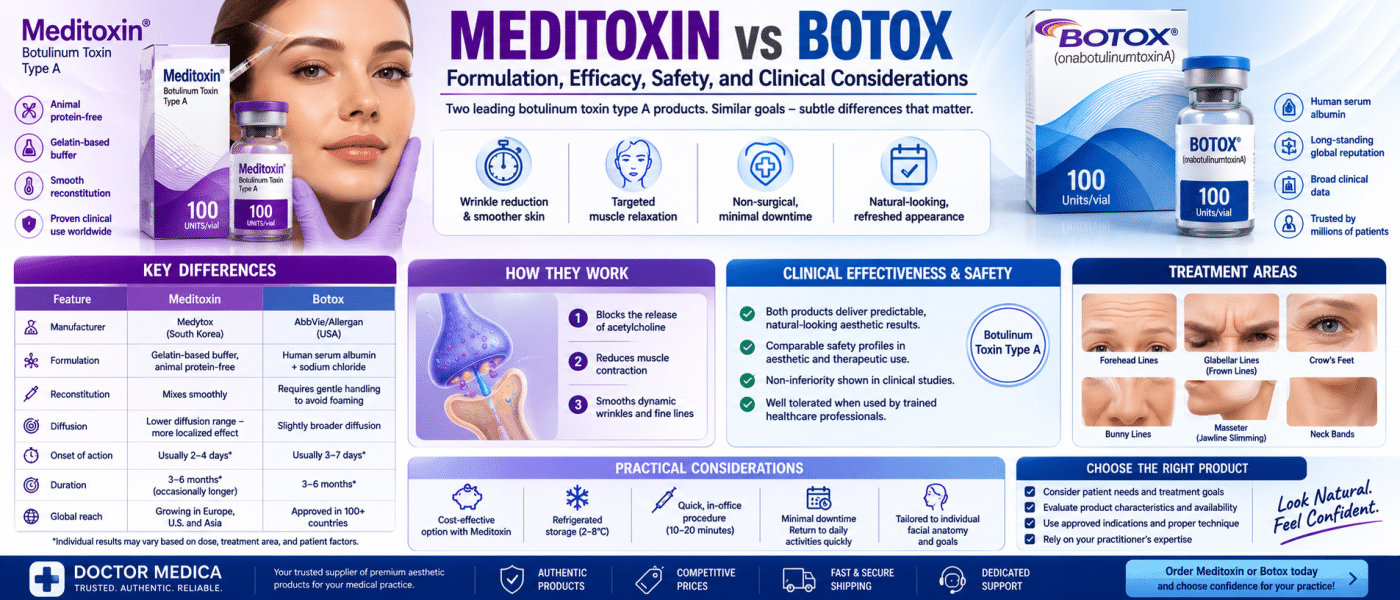
When comparing Meditoxin vs Botox, it is important to recognize that both products contain botulinum neurotoxin type A, but they are not chemically identical formulations.
Botox is manufactured by AbbVie/Allergan and has been used clinically for decades across multiple aesthetic and therapeutic indications. Meditoxin, manufactured by Medytox, is another botulinum toxin type A formulation that has been approved and marketed in a number of international markets.
Both products ultimately act on the same physiological target: the presynaptic nerve terminal. By preventing the release of acetylcholine, they temporarily reduce communication between the nerve and the targeted muscle.
However, the surrounding formulation can differ.
Formulation Differences
Botox contains botulinum toxin type A together with excipients used to stabilize the product, including human serum albumin and sodium chloride.
Meditoxin uses its own proprietary formulation and stabilization system. The precise composition and labeling requirements can vary according to the market in which the product is supplied.
These formulation differences are important for product characterization, but they should not automatically be interpreted as evidence that one product is universally safer or more effective than the other.
Why Formulation Matters
The formulation can influence:
Product stability
Reconstitution characteristics
Storage requirements
Protein exposure
Potential immunogenicity
Handling requirements
Regulatory approval and labeling
For practitioners, these differences are particularly relevant when establishing injection protocols, storage procedures, and patient monitoring practices.
Mechanism of Action
Both Meditoxin and Botox produce their therapeutic effect through temporary neuromuscular blockade.
After injection into a targeted muscle, botulinum toxin binds to nerve terminals and interferes with the release of acetylcholine, a neurotransmitter responsible for triggering muscle contraction.
As acetylcholine release is reduced, the treated muscle becomes less active. In aesthetic medicine, this can soften dynamic wrinkles caused by repeated facial movement.
Common aesthetic treatment areas may include:
Glabellar lines
Forehead lines
Lateral canthal lines
Bunny lines
Masseter-related facial contouring
Other approved facial indications, depending on the product and jurisdiction
The effect is temporary because nerve function gradually recovers through biological processes, including the formation of new nerve terminals.
Onset and Duration: Meditoxin vs Botox
Patients often want to know which product works faster and which lasts longer. However, direct comparisons should be interpreted carefully because treatment dose, injection technique, anatomy, indication, and study design can significantly affect the results.
Feature Meditoxin Botox
Active ingredient Botulinum toxin type A OnabotulinumtoxinA
Mechanism Temporary inhibition of acetylcholine release Temporary inhibition of acetylcholine release
Initial response Usually develops over several days Usually develops over several days
Full clinical assessment Commonly assessed around 1–2 weeks Commonly assessed around 1–2 weeks
Typical duration Often approximately 3–4 months Often approximately 3–4 months
Unit conversion Product-specific Product-specific
Reconstitution Required according to product instructions Required according to product instructions
Regulatory status Varies by country Extensive international regulatory approval
Claims that Meditoxin consistently produces a substantially faster onset or lasts significantly longer than Botox should be treated cautiously unless supported by high-quality comparative clinical evidence.
For practical purposes, individual response and injection technique may have a greater impact on the final result than small differences in reported onset times.
Clinical Efficacy
Both products can provide effective temporary muscle relaxation when administered appropriately.
The clinical outcome depends on several factors, including:
Correct patient selection
Appropriate indication
Injection technique
Muscle anatomy
Dose selection
Injection depth
Treatment pattern
Individual metabolism and response
In aesthetic applications, the goal is generally not complete paralysis of every treated muscle. Instead, experienced practitioners often aim for a controlled reduction in muscle activity while preserving natural facial expression.
This is particularly important in areas such as the forehead, where excessive weakening can contribute to unwanted brow or eyelid changes.
Safety and Potential Side Effects
Both botulinum toxin products have established safety profiles when administered by appropriately trained healthcare professionals and used according to applicable product information.
Most adverse effects are temporary and localized.
Common Reactions
Patients may experience:
Injection-site pain
Mild swelling
Bruising
Redness
Headache
Temporary tenderness
Localized muscle weakness
These effects generally resolve without long-term complications.
Temporary Ptosis and Asymmetry
One of the more recognized aesthetic complications is temporary eyelid or brow ptosis.
This may occur when toxin affects muscles outside the intended treatment area. Precise anatomical knowledge, appropriate dosing, and careful injection technique are therefore essential.
Other temporary aesthetic complications may include:
Facial asymmetry
Uneven brow position
Excessive muscle relaxation
Changes in facial expression
Difficulty performing certain facial movements
Rare Systemic Effects
Although uncommon at recommended aesthetic doses, botulinum toxin products can potentially cause effects beyond the immediate injection site.
Patients should seek medical attention if they experience serious symptoms such as:
Difficulty swallowing
Difficulty breathing
Generalized muscle weakness
Significant speech difficulties
Severe or progressive symptoms
Appropriate patient screening and adherence to approved dosing and administration instructions are essential for minimizing risk.
Immunogenicity and Repeated Treatments
Another consideration when comparing botulinum toxin products is immunogenicity, or the potential for the immune system to develop neutralizing antibodies against the toxin.
Antibody formation is relatively uncommon but may contribute to reduced treatment response in some patients.
Factors that may influence immunogenicity include:
Cumulative exposure
Treatment frequency
Dose
Protein content
Individual immune response
For this reason, clinicians generally avoid unnecessarily frequent injections or excessive dosing when a lower effective dose is sufficient.
It is also important not to assume that a particular excipient automatically eliminates the possibility of antibody formation. No botulinum toxin product can be considered completely free from immunogenicity risk.
Reconstitution, Storage, and Handling
Both Meditoxin and Botox are supplied in formulations that require reconstitution before injection, according to their respective prescribing information and local requirements.
Correct handling is important because inappropriate reconstitution or storage can compromise product quality.
Botox
Botox is supplied as a vacuum-dried powder and must be reconstituted with sterile, preservative-free saline according to the manufacturer’s instructions.
Careful handling is recommended to minimize unnecessary agitation and foaming.
Meditoxin
Meditoxin is also supplied in a form requiring reconstitution before administration. The appropriate diluent, concentration, storage conditions, and handling procedures should always follow the current manufacturer instructions for the specific market and product presentation.
Cold-Chain Storage
Botulinum toxin products generally require controlled refrigerated storage before use. Exact storage requirements, stability after reconstitution, and permitted storage duration should be confirmed using the current official product documentation.
Maintaining the appropriate cold chain is particularly important when products are transported between suppliers, pharmacies, and clinical facilities.
Unit Conversion: An Important Clinical Consideration
One of the most important points when comparing Meditoxin and Botox is that botulinum toxin units are not universally interchangeable.
Even though both products contain botulinum toxin type A, their potency assays are product-specific.
Therefore, practitioners should not assume:
1 unit of Meditoxin = 1 unit of Botox
unless an appropriate conversion has been specifically established for the relevant clinical indication and product.
Treatment decisions should instead follow the product-specific prescribing information, clinical evidence, and professional guidance applicable to the jurisdiction where treatment is performed.
Market Availability and Regulatory Considerations
Botox has an extensive history of regulatory approvals and clinical use worldwide. It is supported by a large body of published research and is approved for multiple aesthetic and therapeutic indications in numerous countries.
Meditoxin has also been approved in several markets, but its availability and approved indications vary geographically.
This distinction is important because a product’s regulatory status in one country does not automatically establish approval in another.
Before purchasing or administering either product, clinics should verify:
Local regulatory authorization
Approved indications
Authorized supplier status
Product authenticity
Storage requirements
Manufacturer documentation
Applicable prescribing information
These considerations are particularly important for practices purchasing products internationally.
Which Is Better: Meditoxin or Botox?
There is no universal answer to whether Meditoxin or Botox is better.
Botox may appeal to practitioners who prioritize:
Extensive clinical history
Broad international availability
Familiarity among clinicians
Extensive regulatory documentation
A large body of clinical research
Meditoxin may appeal to practices where:
The product is appropriately approved and available
Its formulation fits the practitioner’s preferences
Cost considerations are important
Clinicians have appropriate training and experience with the product
Ultimately, product familiarity, regulatory status, clinical evidence, patient anatomy, treatment goals, and practitioner expertise should guide the decision.
Conclusion
Meditoxin and Botox are both botulinum toxin type A products capable of producing temporary muscle relaxation for aesthetic and therapeutic purposes. Their fundamental mechanism is similar, but differences in formulation, manufacturing, regulatory history, labeling, and clinical experience distinguish them.
Botox benefits from a long-established global clinical history and extensive regulatory experience. Meditoxin provides another botulinum toxin type A option in markets where it is appropriately approved and available.
Rather than focusing solely on claims about faster onset, greater diffusion control, or longer duration, practitioners should evaluate the quality of clinical evidence, product-specific instructions, patient characteristics, and their own experience with each formulation.
When used by qualified professionals and according to approved protocols, both products can play an important role in modern aesthetic medicine. The most appropriate choice is ultimately the one that offers appropriate regulatory compliance, predictable clinical performance, and safe patient-centered treatment.